

Megatron BESS
1.6 MW x 3 MWh - Liquid Cooled

Megatron MV Power Block
3.125MW x 12.5MWh

Megatron Battery
125/130kW x 261kWh Cabinet

Megatron BESS
50 kW x 75 kWh

Megatron BESS
100 kW x 150 kWh

Megatron BESS
150 kW x 225 kWh

Megatron BESS
200 kW x 300 kWh
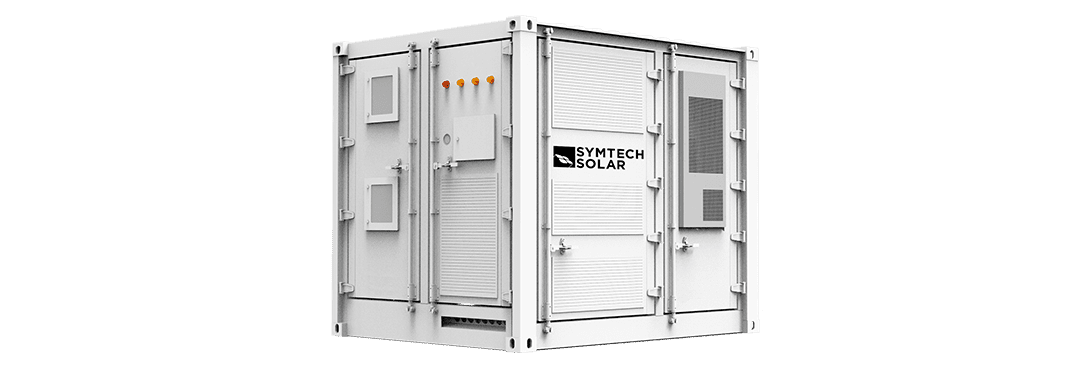
Megatron BESS
300 kW x 1106 kWh

Megatron BESS
500 kW x 1106 kWh

Megatron BESS
500 kW x 1106 kWh

Megatron BESS
1200 kW x 2064 kWh
Battery Energy Storage Systems (BESS)
A battery energy storage system (BESS) stores electricity, whether generated on-site by solar or pulled from the grid, so it can be dispatched later when it’s needed most. For commercial and industrial (C&I) facilities, that flexibility translates directly into lower energy costs, greater resilience during outages, and a path toward meeting sustainability and decarbonization goals. MEGATRON Battery Energy Storage Systems from Symtech Solar are pre-engineered, fully integrated systems ranging from 50 kW to multi-megawatt utility-scale configurations, built to drop into a facility’s electrical infrastructure with minimal on-site engineering.
All MEGATRON systems ship with every component pre-installed at the factory for quicker, easier site installation (shipped using UN 3536 standards).

Applications
Understanding how a battery energy storage system works starts with the power path. Energy flows from the lithium iron phosphate (LFP) battery cells into the racks, where the Battery Management System (BMS) continuously monitors cell voltage, temperature and state of charge (SOC) to keep every string balanced and within safe operating limits.
From the racks, power moves through the high voltage unit and into the Power Conversion System (PCS), which converts stored DC energy to grid-ready AC power (and back again during charging). Larger MEGATRON systems, including the MEGATRON MV Power Block Series, use a dual-PCS architecture that splits conversion across two independent paths, increasing usable throughput and giving the system built-in redundancy if one PCS path needs maintenance.
That architecture, paired with the system’s rated C-rate and depth of discharge (DoD), determines how much usable capacity and power the BESS can deliver on demand. On larger PV-plus-storage projects, planning also means aligning two parallel commissioning tracks on the way to commercial operations (COD): the PV performance test and battery FAT/SAT.
Battery Energy Storage System Warranties
MEGATRON Battery Energy Storage Systems offer multiple warranty coverages, from the cell level to the entire system, so your system stays backed by a robust set of warranties for long, trouble-free operation. For larger custom Battery Energy Storage Systems, our team can fly on-site for commissioning support.
Warranty terms are measured against the same baseline established during factory and site acceptance testing (FAT/SAT), where usable capacity and round-trip efficiency are first recorded. Optional extended warranty coverage is available upon request.


Battery Management System
Every MEGATRON battery energy storage system incorporates a battery management system (BMS) built on a 3-layer architecture. Together, this hierarchy performs high-precision analog signal detection and reporting, fault alarm generation, uploading and storage, battery protection, parameter setting, active balancing, battery SOC calibration, and information exchange with other site devices, including the site’s SCADA platform.
A well-designed BMS is what separates a battery system that degrades predictably and safely over its rated life from one that fails early or, in the worst case, enters thermal runaway. It’s the layer that makes high-cycle applications like EV charging safe to run hard, day after day, and gives an operations team the confidence to lean on solar-plus-storage without babysitting it.
3-Layer Architecture
Key Features

The BMS also maintains continuous communication with the site’s SCADA and grid interconnection equipment, keeping protection settings aligned with what was approved during commissioning under IEEE 1547-2018. It performs 24/7 in real time, providing continuous data on cell voltage, cell temperature, connection cable terminal temperature, and battery string voltage, current, SOC and SOH (state of health), the same baseline metrics that commercial operations (COD) acceptance testing establishes and every future degradation or warranty claim gets measured against.
Because the BMS reports SOC and SOH continuously rather than at scheduled intervals, degradation trends show up early, giving owners time to plan maintenance, adjust cycling patterns, or file a warranty claim while the system is still well within its certified operating parameters. That same data also feeds the cloud-based monitoring platform described above, so load monitoring, demand tracking and cost reporting are all built on the same trusted, cell-level source of truth.
Fire Fighting &
Suppression System
Fire safety in a MEGATRON battery energy storage system is a layered design, not a single component. The liquid-cooled cabinet system uses aerosol fire suppression, installed on the door of each cabinet, working alongside a smoke detector and a heat detector that continuously report status to the BMS. If either detector triggers an alarm, the signal is sent to the BMS, and the entire system is shut down through the EMS controller, isolating the fault before it can propagate.
MEGATRON systems also incorporate explosion relief venting, engineered to release overpressure generated by a thermal runaway or arc-flash event before it can compromise the cabinet structure or put personnel at risk. Together, this detection, suppression and pressure-relief architecture is what MEGATRON systems are certified against under UL 9540A thermal-runaway propagation testing, alongside NFPA 69 and NFPA 855 fire protection standards.
Detection, Suppression & Response
Because container layout, cell density and system scale vary across the MEGATRON lineup, from 50 kW cabinet units up through the multi-container MEGATRON MV Power Block Series, the specific fire suppression and detection configuration is matched to each system’s design and container layout, and validated during factory and site acceptance testing (FAT/SAT) before a system ever goes live.
