
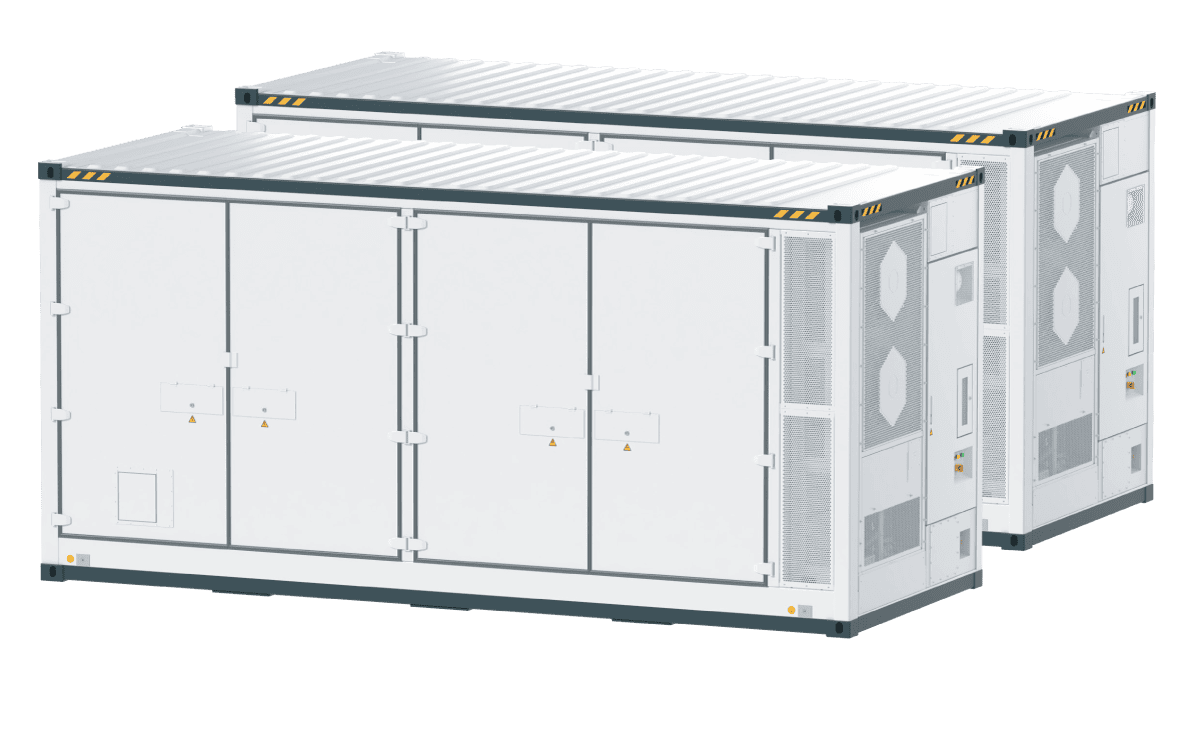
The MEGATRON MV Power Block is a factory-built, four-hour storage unit that pairs two 6.25 MWh liquid-cooled LFP battery containers with a single 33 kV medium-voltage skid, so a project buys 3.125 MW of power and 12.5 MWh of energy behind one grid connection. It is aimed at the work that defines large storage today: shifting midday solar into the evening peak, arbitraging off-peak and peak tariffs, trimming demand charges at heavy industrial loads, firming a PV or wind plant, holding voltage and frequency on a weak network, and black-starting a site or microgrid when the grid is not there. Everything between the cells and the ring main unit is assembled, wired and tested in the factory, so what lands on site is one repeatable block rather than a set of components to integrate.
Utility-scale storage procurement has quietly shifted away from buying components and toward buying blocks. Instead of specifying battery containers, a power conversion system, a step-up transformer and switchgear separately, then paying an integrator to make them talk to each other on site, developers increasingly buy one pre-engineered building block: a fixed quantity of energy, a fixed quantity of power, and a single medium-voltage connection point that lands on the collector bus.
The MEGATRON MV Power Block is built for exactly that procurement model. It arrives as three standard 20 ft enclosures and leaves the site as a single grid-compliant asset. Here’s what’s inside it, what the numbers actually mean, and how the block scales.
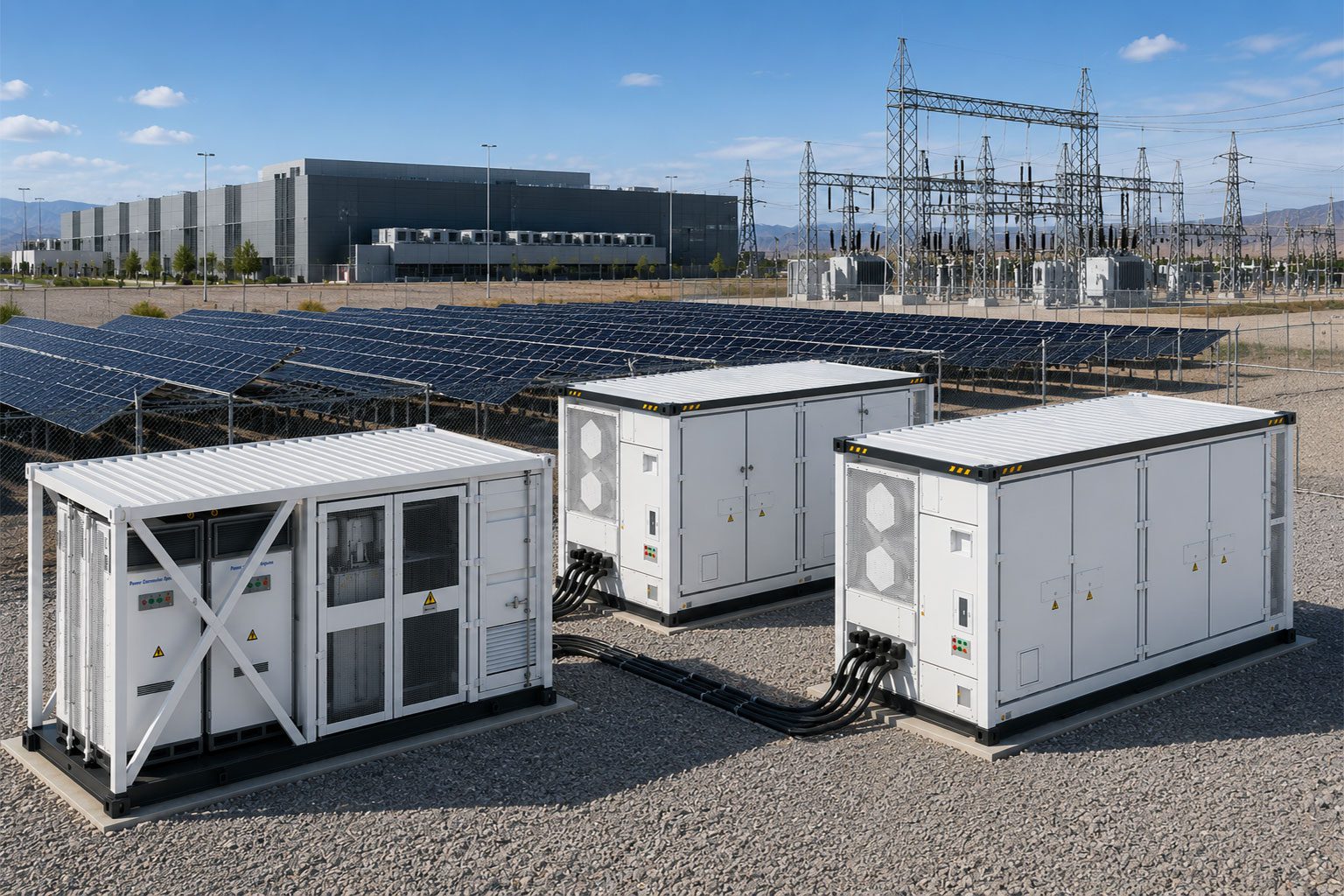
What the MEGATRON MV Power Block Actually Contains
A block is the smallest repeatable unit of a large storage plant. Everything between the cells and the ring main unit is inside it, which means the interfaces a project engineer has to manage shrink to three: MV cable, communications, and auxiliary power.
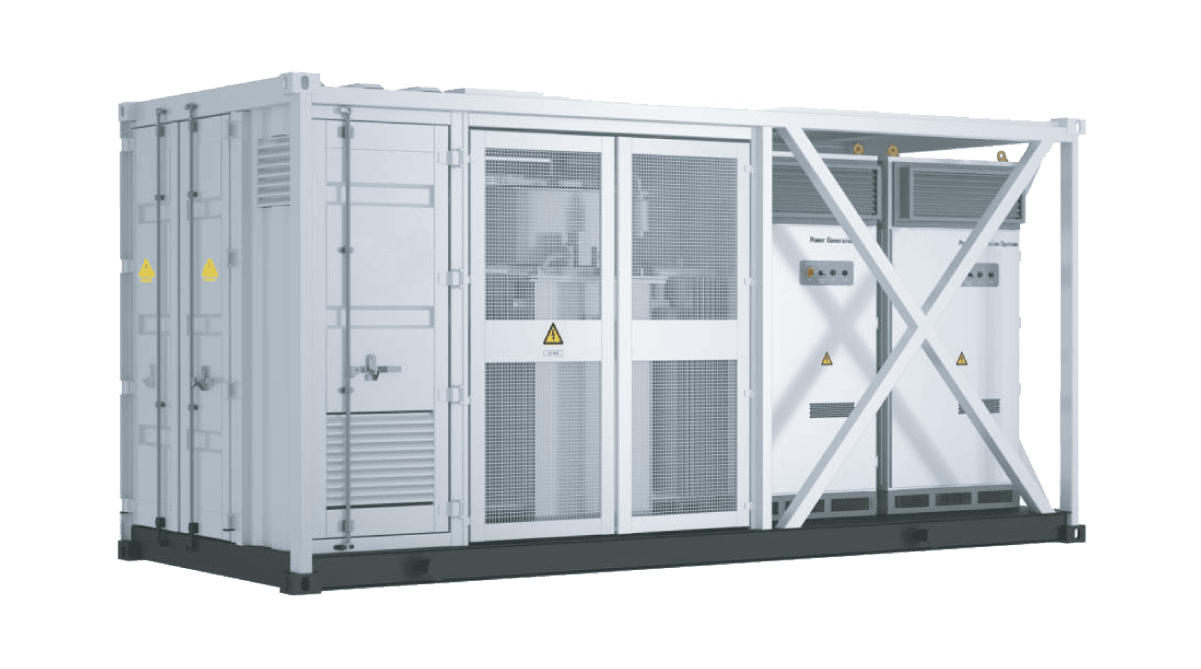
The MEGATRON MV Power Block contains:
- Two 6.25 MWh battery containers. Liquid-cooled, prismatic LFP, IP55, 20 ft footprint, 48,000 kg each.
- One 33 kV MV skid. Two bidirectional PCS units, an oil-immersed step-up transformer, ring main unit switchgear, protections, UPS and communications, all in a 20 ft enclosure at 19,000 kg.
- One grid connection. 6.6 to 33 kV, 50 or 60 Hz, three-phase three-wire, ready to daisy-chain to other RMUs on the collector circuit.
That packaging is the main reason containerised architectures have taken over commercial and utility-scale projects, a trend covered in more depth in our look at the BESS market in 2026.
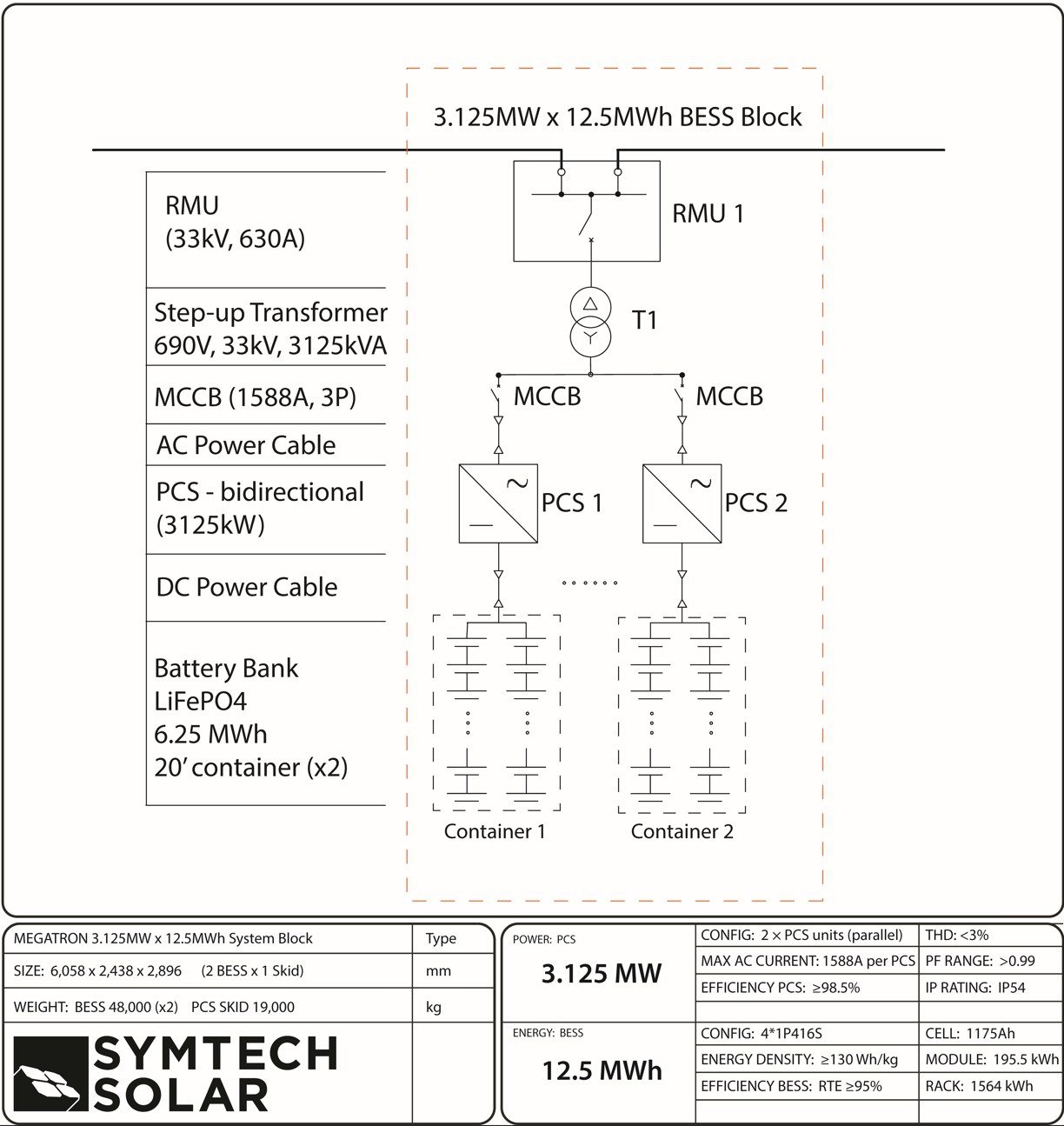
Why 3.125 MW and 12.5 MWh Are the Same Number
The two headline figures on the MEGATRON MV Power Block aren’t independent specifications. They’re the same system described at two different rates.
Divide 12.5 MWh of nominal energy by a 4-hour discharge and you get 3.125 MW. That’s the 0.25 P charge and discharge rate the cells and thermal system are designed around, and it’s why the block is rated the way it is. The MV skid can push harder: on the AC side it is rated 3,150 kVA nominal with 3,465 kVA of continuous overload capability, built around an S11 series 3,150 kVA oil-immersed transformer, and the PCS pair has headroom above that. But sustained operation above 0.25 P shortens the discharge window and pushes the batteries outside the conditions the round-trip efficiency figure was measured at.
This matters when a project is sized against a tariff rather than a duration. A 4-hour block is a poor fit for a 30-minute frequency-response contract and an excellent fit for evening peak shifting, demand-charge management, or firming a PV plant across a cloudy afternoon. Getting that duration decision right ahead of procurement is the single largest driver of storage project economics. Our battery system ROI calculator is a reasonable place to sanity-check the assumptions before locking in a block count.
Inside the 6.25 MWh Battery Container of the MEGATRON MV Power Block
Each container in the MEGATRON MV Power Block is configured as 4 x 1P416S using 1,175 Ah prismatic LFP cells. Working that through: 416 cells in series at 3.2 V nominal gives 1,331.2 V, and 1,331.2 V x 1,175 Ah works out to roughly 1,564 kWh per rack. Four racks land the container at about 6.25 MWh, built up from 195.5 kWh modules.
Liquid Cooling and Thermal Uniformity
The container operates from -30°C to +55°C, with -20°C to +35°C recommended for storage. Liquid cooling is doing more work here than a raw temperature range suggests: the practical benefit is thermal uniformity across racks, which limits the cell-to-cell divergence that drives capacity fade and BMS balancing overhead in air-cooled designs. We covered the mechanism in detail in our post on liquid cooled battery energy storage systems.
Cycle Life and Augmentation Planning
Cell-level cycle life is rated at 11,000 cycles or better. At one full cycle per day that’s roughly 30 years, which puts the binding constraint on calendar ageing and warranty terms rather than throughput for most single-cycle-per-day applications. Projects running two cycles a day, or cycling hard on a merchant arbitrage strategy, should still model augmentation, but they’re modelling from a comfortable starting point.
BMS and Monitoring
A 3-level BMS handles cell, module and system monitoring, with CAN, RS485 and Ethernet communication. That data needs to land in the same repository as the rest of the plant’s telemetry rather than a vendor portal, a point we make in the context of how battery management systems protect an ESS.
The 33 kV MV Skid: Where the MEGATRON MV Power Block Meets the Grid
The MV skid is what turns two battery containers into a connectable asset. It houses two bidirectional three-level PCS units, an S11 series oil-immersed step-up transformer (Dy11 vector, ONAN or KNAN cooling), and ring main unit switchgear rated at 36 kV, 630 A, with a 20 to 25 kA short-circuit rating and SF6 insulation, or an SF6-free option at 24 kV and below.
Power Quality and Grid Compliance
PCS efficiency is 98.5% with a three-level topology, DC input range of 1,050 to 1,500 V, and LV output at 690 V nominal before step-up. On the AC side the skid delivers under 3% THD at nominal power, a power factor range of 0.9 leading to 0.9 lagging, and harmonic performance aligned with IEEE 1547-2018 and Engineering Recommendation G5/5. Protections include DC disconnector plus fuse, motorised AC breaker, Type II surge arresters, insulation monitoring devices, transformer relays for pressure, temperature and gassing, and smoke detection.
Supported protocols run to CAN, Modbus, IEC 60870-103 and IEC 61850, which matters when a utility or offtaker specifies a SCADA integration standard rather than accepting a vendor gateway.
Grid-Forming Control and Black Start
The block operates in grid-following mode on-grid and grid-forming mode when islanded, establishing its own voltage and frequency reference, with black start capability to bring a site back without external supply. For anyone weighing which control mode a project actually needs, our comparison of on-grid, off-grid and hybrid storage systems breaks down the operational differences.
Round-Trip Efficiency: What You Actually Get at the Meter
The MEGATRON MV Power Block datasheet quotes battery RTE of 95% or better (DC side, 0.25 P, 25°C) and PCS efficiency of 98.5% or better. Those aren’t additive, and they aren’t the number that shows up in a revenue model.
An AC-to-AC round trip passes through the PCS twice, once charging and once discharging. So the realistic figure is roughly 0.95 x 0.985 x 0.985, or about 92%, before transformer losses and auxiliary consumption. Auxiliary load is where liquid cooling earns its keep or costs you: the MV skid draws 11.6 kVA at peak, and container cooling load varies with ambient conditions and cycling intensity. Budget accordingly in hot climates.
Quoting 95% RTE in a financial model without accounting for the conversion path and auxiliaries is one of the more common ways storage projects end up underperforming their pro forma.
Safety, Fire Protection and Certification
The containers use flame-retardant module top covers and multi-stage active fire detection and protection compliant with NFPA 855, alongside the 3-level BMS. Battery-side compliance references the IEC, UL and NFPA families; the MV skid references CE, VDE, IEC and EN.
Certification is not a box-ticking exercise at this scale. The EPRI BESS Failure Incident Database is the best public record of what actually goes wrong in fielded systems, and it’s worth reading before finalising spacing, ventilation and emergency response planning with an AHJ. For North American projects specifically, see how MEGATRON racks and systems are certified to UL 9540A and UL 1973.
Site Planning for the MEGATRON MV Power Block: Footprint, Weight and Environment
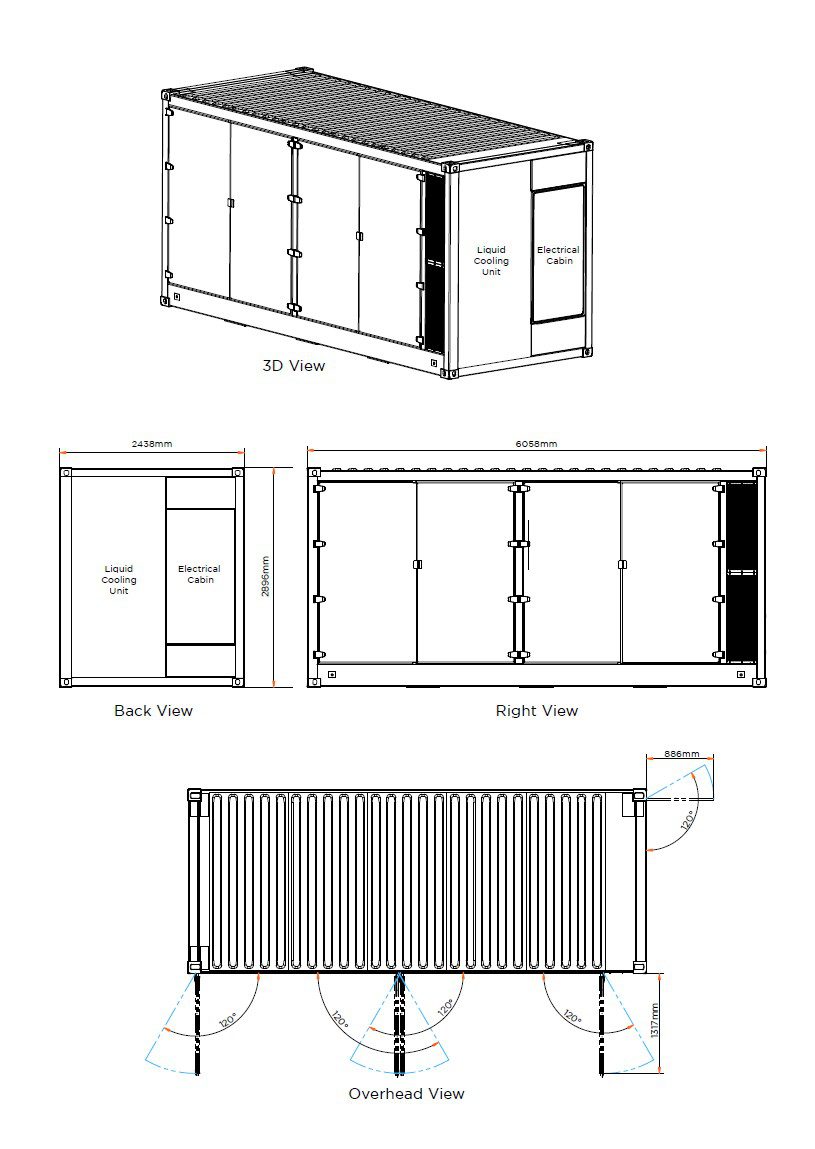
Three 20 ft enclosures at 6,058 x 2,438 mm each work out to roughly 44 m² of container footprint per MEGATRON MV Power Block, before service clearances, fire separation and cable routing. Container doors need 120° swing clearance, and the block layout drawing calls out 886 mm and 1,317 mm access dimensions worth carrying into the civil design early.
Total block weight is about 115 tonnes: 48 tonnes per battery container plus 19 tonnes for the skid. Foundation design and crane access should be checked against those figures, not against a generic container assumption.
Environmental limits are broad enough for most sites. The batteries run -30°C to +55°C, the skid -35°C to +60°C with derating above 45°C. Altitude is the spec most often missed: the battery containers are rated to 4,000 m, the skid to 5,000 m with derating above 3,000 m, so a high-altitude site is limited by the batteries rather than the skid. The containers carry a C5-M corrosion protection grade, which is the relevant spec for coastal and industrial installations.
Scaling the MEGATRON MV Power Block
Because the RMU is designed to chain to other RMUs, block count is the only real scaling variable. Eight blocks give a 25 MW / 100 MWh plant on a single collector architecture. Sixteen give 50 MW / 200 MWh. The engineering that changes between those cases is collector design, protection coordination and controls, not the block itself.
Below this scale, the same architecture appears in smaller increments. The MEGATRON 1.6 MW liquid-cooled BESS and the rest of the MEGATRON BESS range cover commercial and industrial projects that don’t need a full MV block.
Delivery, Commissioning and COD
Containers ship pre-assembled at 27% nominal state of charge under UN 3536, the classification we cover in our guide to LFP battery storage shipping classifications. Factory pre-assembly is what compresses the on-site schedule, but it doesn’t remove the testing burden, it relocates it.
Factory acceptance testing catches configuration and build defects before a 48-tonne container spends six weeks on a ship. Site acceptance testing then confirms the system survived transit and integrates correctly with site SCADA and protection. Our breakdown of FAT and SAT procedures for battery systems walks through both.
On hybrid projects, the storage commissioning track runs in parallel with the PV performance test rather than after it, and both have to close before the asset reaches commercial operations. Our guide to achieving commercial operations in large-scale PV and battery storage systems covers how to schedule the two tracks together, with a South Africa specific version for projects working through NERSA and network service provider approvals.
Frequently Asked Questions
What does the MEGATRON MV Power Block (3.125 MW x 12.5 MWh) cost?
Pricing depends on configuration, destination, grid code requirements and volume, so any single figure is misleading. For benchmarking assumptions in a financial model, the NREL Annual Technology Baseline publishes current utility-scale storage cost ranges. For a project-specific quotation on the MEGATRON MV Power Block, contact Symtech Solar directly.
How much land does a utility-scale BESS block need?
About 44 m² of container footprint for the three 20 ft enclosures, plus door swing clearance, fire separation distances set by the applicable code and AHJ, cable routing and maintenance access. Plan on a multiple of the raw footprint rather than the footprint itself.
Can the block run without a grid connection?
Yes. The MV skid in the MEGATRON MV Power Block provides grid-forming control to establish voltage and frequency in islanded mode, plus black start capability. Off-grid and microgrid operation is a design case, not a workaround, though it changes control, protection and sizing requirements substantially.
How many blocks make a 100 MWh plant?
Eight, at 25 MW / 100 MWh. Collector design, protection coordination and plant-level controls scale with block count; the block architecture does not change.
Download the MEGATRON MV Power Block Series Datasheet
Final Thoughts
The value of a pre-engineered block like the MEGATRON MV Power Block isn’t the specification sheet, it’s the reduction in interfaces. Every connection point between separately procured components is a place where responsibility gets contested during commissioning, and a place where a schedule slips. Buying energy, power and an MV connection as one factory-tested unit moves that risk upstream to the factory floor, where it’s cheaper to resolve.
The numbers still need checking against the application. A 4-hour block at 0.25 P is the right shape for peak shifting, demand-charge management and renewable firming, and the wrong shape for short-duration ancillary services. Get the duration and the realistic AC round-trip efficiency into the model early, and the rest of the engineering follows.
Symtech Solar’s EPC team can help size, specify and commission utility-scale storage blocks, from load profile analysis through factory acceptance testing and grid compliance documentation.