
In 2026, the battery energy storage system (BESS) industry is experiencing one of its most transformative periods in history. Record deployments, evolving battery chemistries, and entirely new demand drivers — from AI data centers to utility-scale renewable firming — are reshaping how energy storage is planned, procured, and deployed worldwide. Whether you’re a commercial developer, industrial facility manager, or renewable energy investor, here’s what the latest global BESS trends mean for your next project.
Global BESS Deployment Is Surging
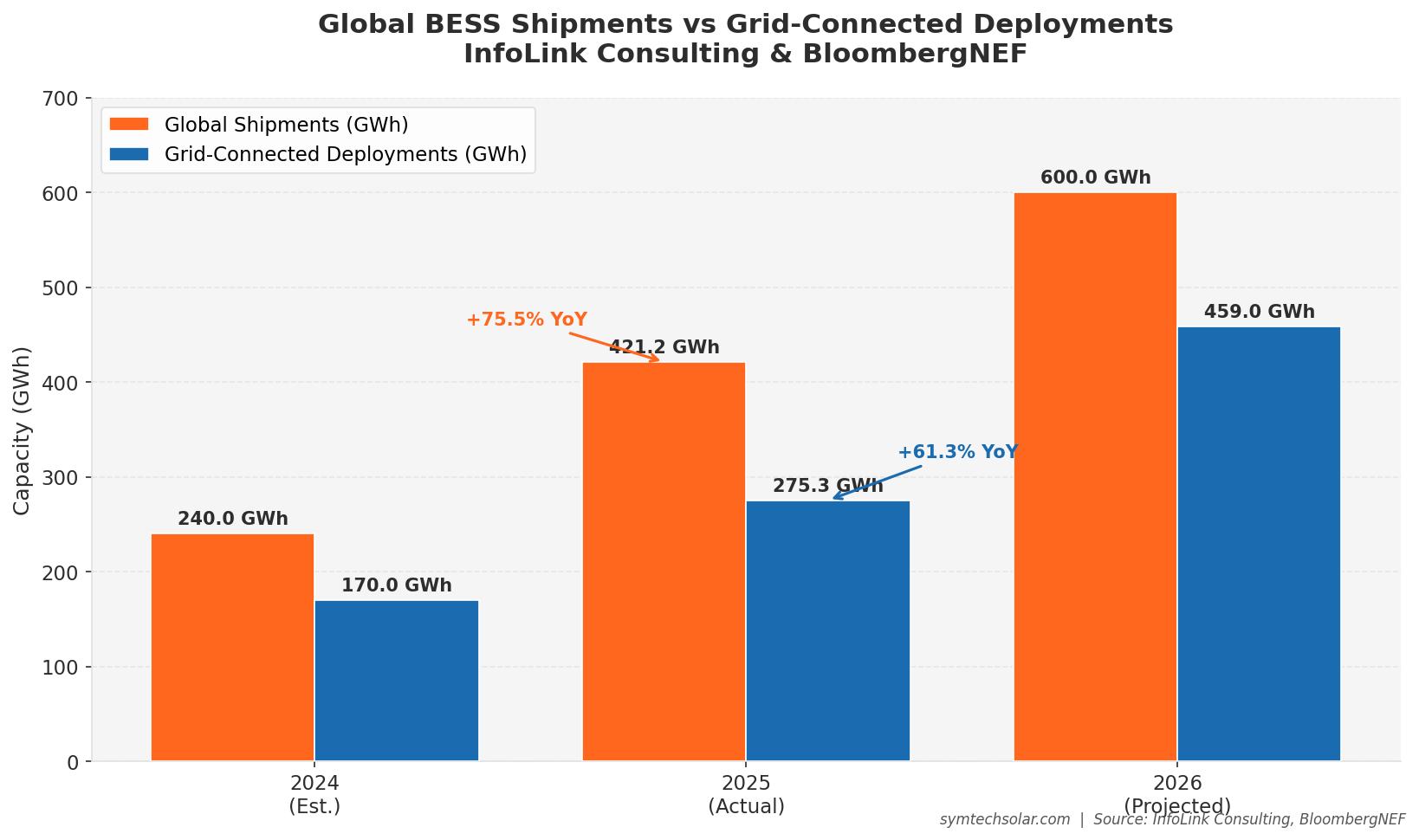
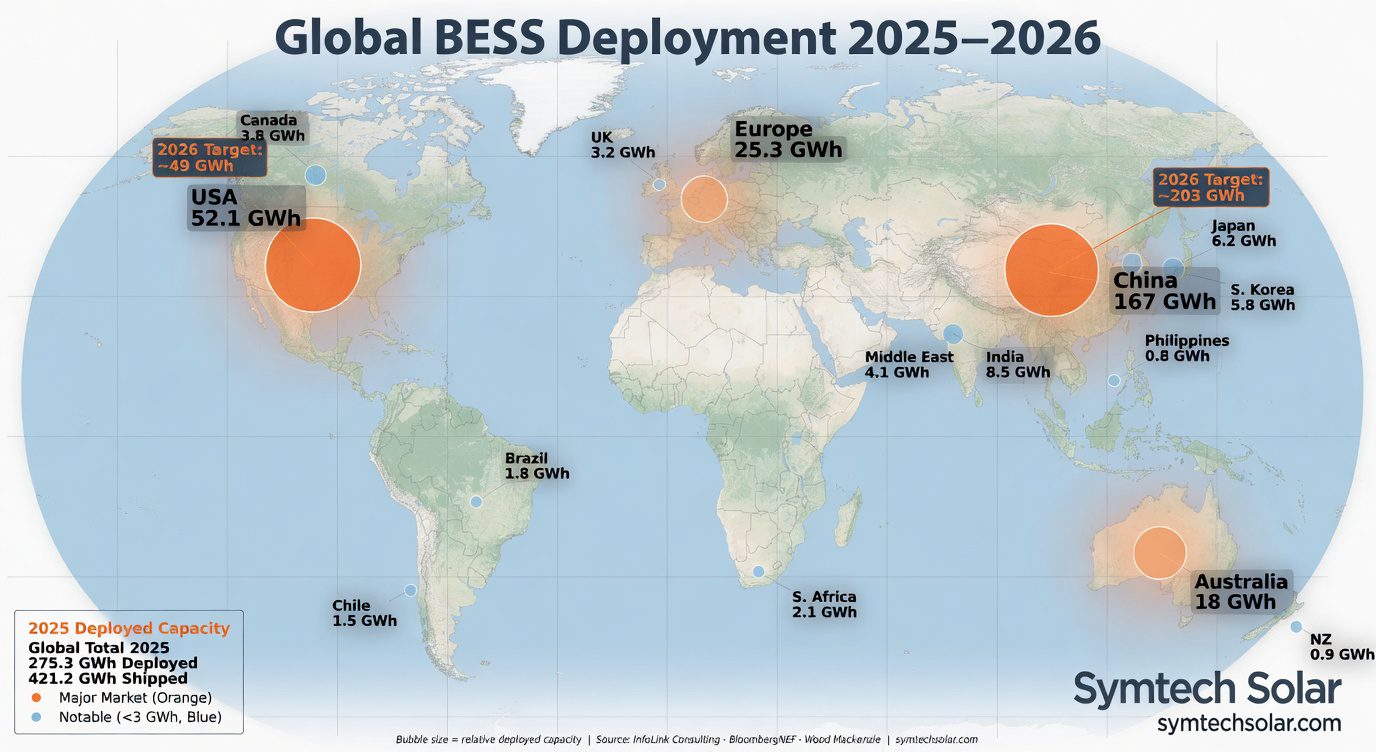
The scale of growth in 2026 is remarkable. According to InfoLink Consulting, global shipments of battery energy storage systems reached 421.2 GWh in 2025 (+75.5% year-over-year), with projections around 600 GWh for 2026. Actual grid-connected deployments hit 275.3 GWh in 2025 (+61.3%), and BloombergNEF forecasts approximately 459 GWh of new deployments in 2026. This surge is fueled by accelerating renewable energy integration, grid modernization, and emerging demand from AI data centers across Asia, the Americas, and Europe.
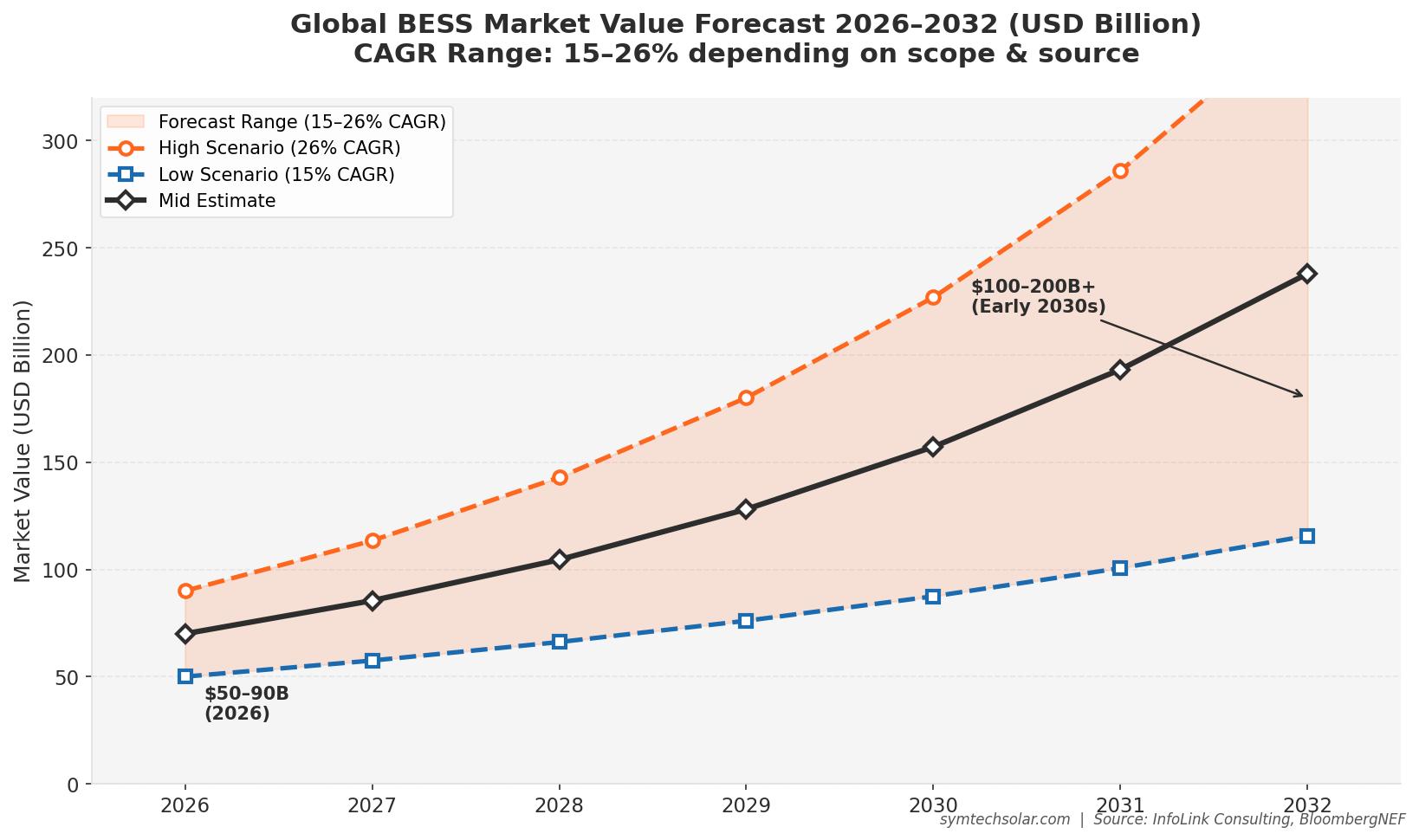
Looking ahead, the global BESS market is experiencing robust expansion. Recent forecasts place the market value in the range of USD $50–90 billion in 2026, with strong potential to reach USD $100–200 billion by the early 2030s at CAGRs typically cited between 15–26% depending on the source and scope (utility-scale vs. broader energy storage). This reflects not just volume growth but also maturing project economics, technology improvements, and policy support worldwide. This isn’t a niche trend — it’s a fundamental restructuring of how the world stores and delivers electricity.
LFP Remains the Dominant Chemistry — But Cell Formats Are Evolving
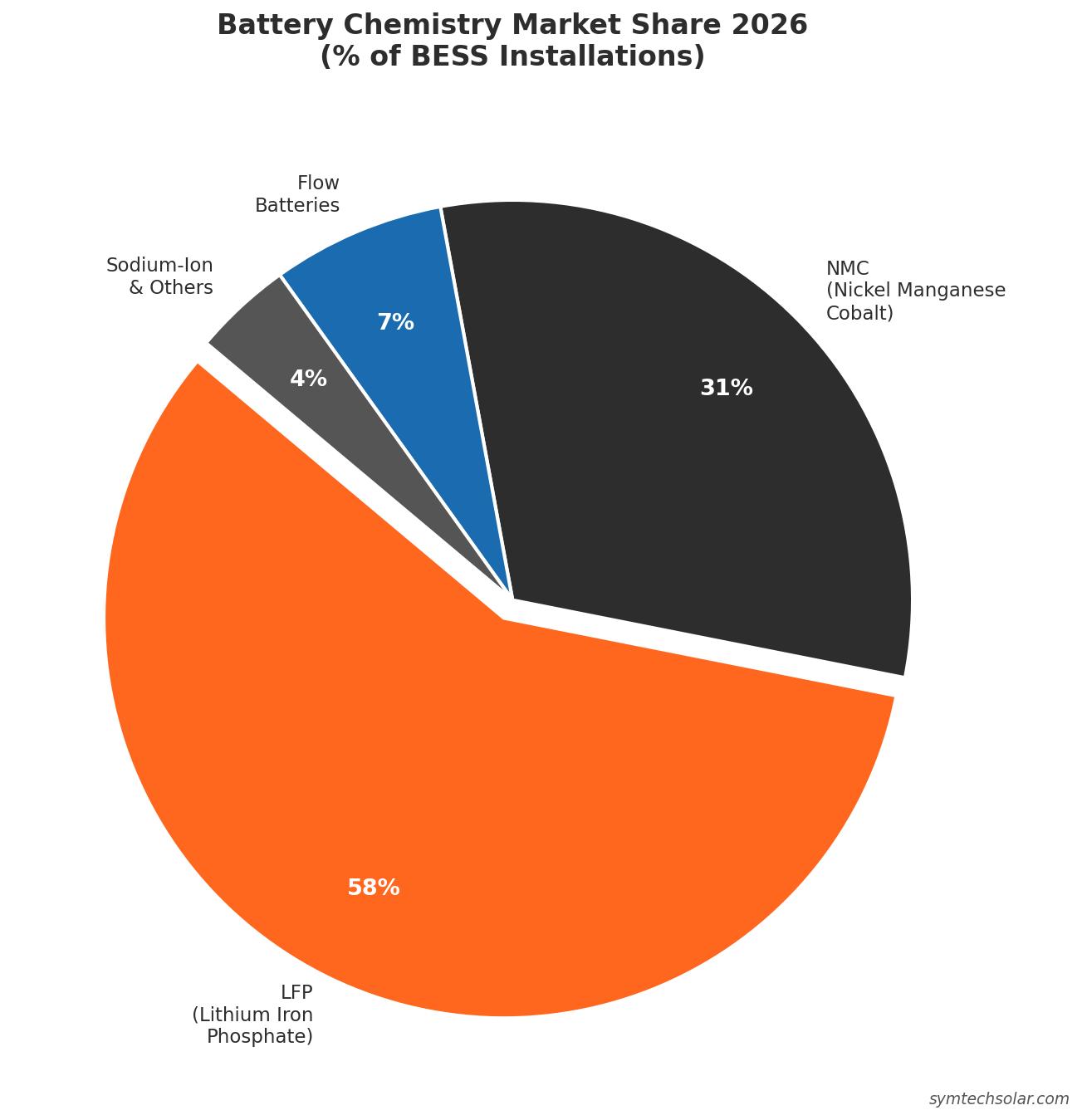
Lithium Iron Phosphate (LFP) continues to lead the global BESS market by a wide margin, accounting for 58% of all lithium-based BESS installations. In 2025, LFP demand grew 48% year-on-year — outpacing all other battery chemistries — driven by its combination of safety, long cycle life, and declining cell costs.
Within LFP, the hardware itself is also advancing. Manufacturers are now rolling out larger-format prismatic cells, with 5 MWh enclosures in standard 20-foot ISO containers becoming the new benchmark in 2025, using 300 Ah+ cells. This means more energy per container footprint, faster deployment, and improved project economics — all of which directly benefit containerized BESS projects.
Symtech Solar’s Megatron BESS series is built on the latest LFP cell technology, ensuring our customers benefit from these advancements within factory-tested, pre-certified, plug-and-play enclosures.
Sodium-Ion: A Chemistry to Watch — But Not Replace LFP Yet
One of the most discussed topics across the BESS industry in 2026 is sodium-ion (Na-ion) battery technology. CATL introduced its Naxtra sodium-ion battery earlier this year, offering up to 175 Wh/kg as a lower-cost, lithium-free alternative for stationary storage. In the United States, sodium-ion BESS developer Peak Energy has signed a commercial agreement with Jupiter Power for a 180 MW / 720 MWh project, with potential for 4 GWh in further orders.
Market analysts project the global sodium-ion battery market could surge from 70 GWh today to approximately 400 GWh by 2030. However, for commercial and utility-scale projects being developed today, LFP remains the commercially proven and cost-competitive choice. Cost parity between sodium-ion and LFP is not expected before 2035. Na-ion is a chemistry worth monitoring closely — but not one to base your current project decisions on.
Record-Scale Projects Commissioned Worldwide
Individual BESS projects are also reaching new scale milestones in 2026:
- A 250 MW / 1,000 MWh energy storage project began commercial operations in Ontario, Canada, through a joint venture between Ameresco and Atura Power.
- Contact Energy commissioned a 100 MW / 200 MWh BESS at New Zealand Steel’s Glenbrook site — its first grid-scale storage project.
- Spearmint Energy closed a US$450 million financing package to support its 300 MW / 600 MWh Red Egret BESS project.
- Ørsted acquired a 150 MW BESS in Michigan from developer ESA Solar Energy.
- In Australia, two major BESS projects — including a 400 MW / 2,000 MWh system to be co-located with a solar PV plant in Queensland — cleared federal environmental approvals, adding to the country’s rapidly growing storage pipeline.
These projects reflect a global market that has moved well beyond pilot-scale — utility and institutional investors now view large-scale BESS as a core infrastructure asset class.
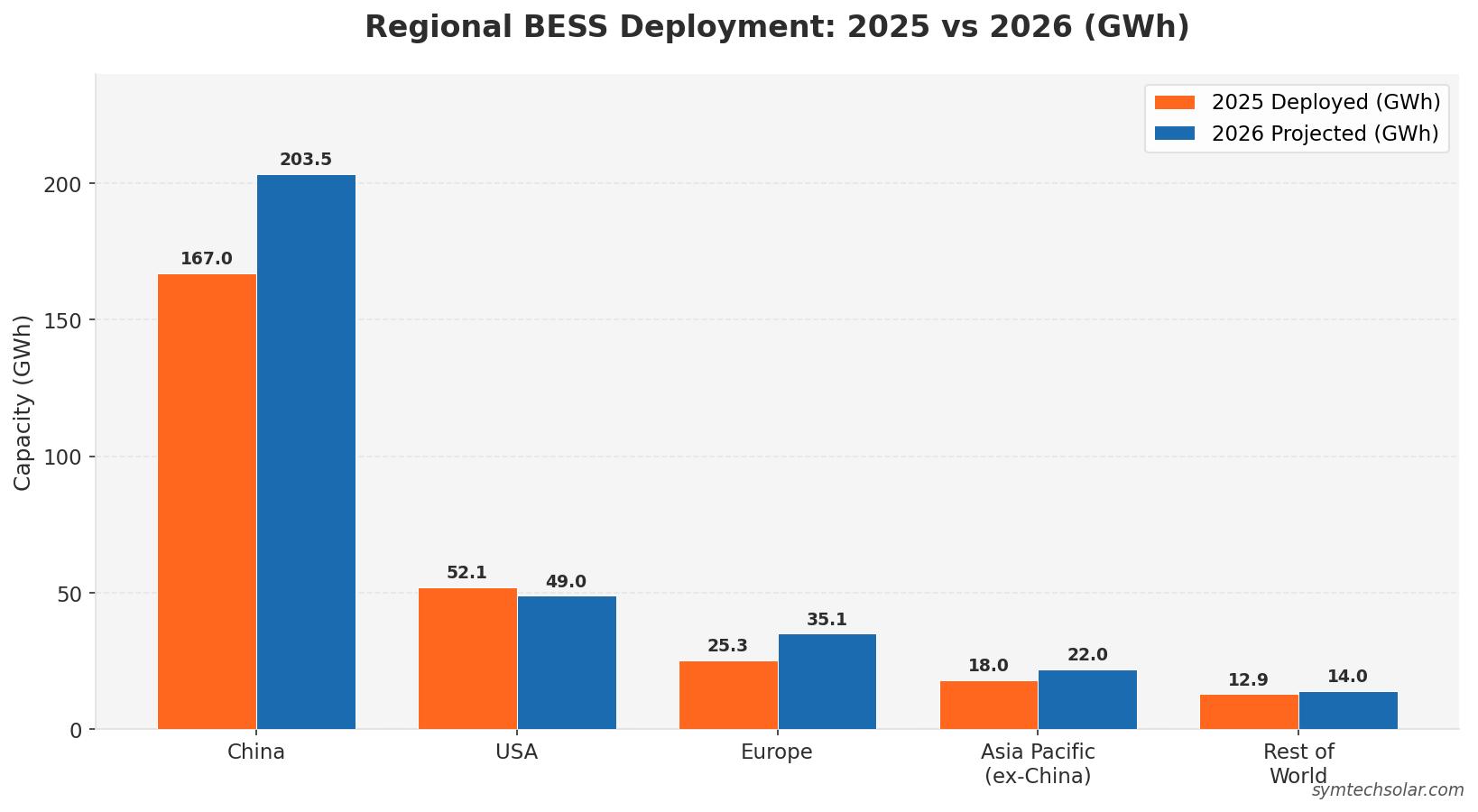
The map above illustrates just how global the BESS revolution has become. While China continues to lead with 167 GWh of deployed capacity in 2025, markets across North America, Europe, Asia Pacific, and beyond are scaling rapidly. No region is standing still — and with 600 GWh of global shipments projected for 2026, the next wave of major deployments is already underway.
AI Data Centers: The Unexpected New BESS Driver
Perhaps the most surprising growth driver of 2026 is the rapid expansion of AI-powered data centers. As these facilities consume an ever-larger share of grid capacity, on-site energy storage is evolving beyond traditional uninterruptible power supply (UPS) applications. Battery systems deployed alongside data centers are increasingly capable of supporting grid frequency regulation and demand response — creating a new commercial vertical for BESS integrators and project developers.
This opens significant opportunities for modular, containerized BESS systems — particularly for C&I (commercial and industrial) customers looking to reduce peak demand charges while also providing grid services or backup power for critical loads.
What This Means for Your Next BESS Project
The 2026 BESS market is moving fast, but the key project fundamentals remain consistent:
- LFP containerized BESS is the proven, bankable technology for commercial and utility-scale projects today.
- Modular, scalable systems are in highest demand — the ability to start with a single container and expand to multi-MWh by parallel connection is a critical project finance and flexibility advantage.
- Factory pre-testing and certification to standards such as UL 9540, IEC 62619, IEC 63056, and IEEE 1547 is increasingly non-negotiable for project bankability, insurance compliance, and grid interconnection approval.
- Speed to deployment remains a key differentiator — containerized BESS eliminates most civil works and reduces commissioning timelines from months to weeks.
Symtech Solar Containerized BESS Solutions
The Symtech Solar Megatron, Apollo, and Hercules series are fully containerized LFP BESS platforms available from 125 kW / 261 kWh up to multi-MW/MWh configurations. All models are factory-direct, pre-certified to UL 9540, IEC 62619, IEC 63056, and IEEE 1547 standards, and engineered for seamless integration with on-grid, off-grid, or hybrid solar PV systems.
With the global BESS market expanding at record pace, there has never been a better time to lock in a high-performance, cost-competitive storage solution for your renewable energy project.
Conclusion
The BESS boom of 2026 is being driven by converging forces: falling LFP cell costs, larger container formats, record utility-scale deployments, and new demand from AI infrastructure. For project developers, C&I customers, and utilities alike, containerized BESS offers the optimal combination of technical performance, deployment speed, and long-term reliability needed to capitalize on this moment in the energy transition.
Contact the Symtech Solar engineering team for detailed specifications, sizing assistance, or a customized proposal for your next BESS project.
https://www.symtechsolar.com/battery-energy-storage-systems/