
Solar-plus-storage has moved from “emerging trend” to default configuration faster than almost anyone in the industry predicted. U.S. battery storage installations hit a record 18.9 GW in 2025, a 52% jump over 2024, with the residential segment alone growing 92% year over year (Wood Mackenzie). For installers and system designers, that growth curve translates directly into a practical question that comes up on nearly every job now: how does the storage system actually connect to the existing electrical service under NEC 705.12? For more on the market forces behind this shift, see our breakdown of The BESS Market 2026: Global Trends Reshaping Energy Storage.

Why Storage Is No Longer an Add-On
A decade ago, batteries were mostly bolted onto PV systems for backup power or off-grid use. Today, storage is doing real economic work: shifting solar production to match evening demand, avoiding peak demand charges for commercial customers, and smoothing the “duck curve” that utilities in high-solar-penetration regions have been managing for years. We covered the underlying grid-balancing case in How Energy Storage Can Solve the Renewable Energy Generation Issue, and the dynamic hasn’t changed, it has only accelerated as more utilities adopt time-of-use rates and demand charges.
What has changed is the incentive landscape, and installers need to be direct with clients about it. The 25D federal tax credit for customer-owned residential solar and storage expired at the end of 2025 under the One Big Beautiful Bill Act, with no phase-down (EnergySage). Leased and PPA-financed residential systems can still pass through commercial credit value if construction starts before July 2026 or the system is placed in service by 2028. Commercial storage fares considerably better: Section 48E’s 30% investment tax credit remains available for standalone battery projects beginning construction through 2033, even as the matching solar credit narrows toward a 2027 placed-in-service deadline (Sunwise). In practice, this is pushing more of the storage conversation toward commercial and industrial scale, where we’ve seen strong adoption, as discussed in Commercial Uses of Lithium-Ion Battery Systems in Stationary Energy Storage.
Where the Interconnection Actually Happens: NEC 705.12(B)
Once a system is sized and financed, it has to physically and legally connect to the building’s electrical service. In the U.S., that connection is governed by Article 705 of the National Electrical Code, specifically the NEC 705.12(B) load-side connection rules, meaning connections made anywhere on the customer’s side of the main service disconnect rather than directly at the utility supply. Five distinct paths are permitted, and each one changes what an installer can and cannot do on a given panel. One caution worth flagging up front: the exact subsection lettering under 705.12(B) has shifted with nearly every code cycle (the “120% rule” alone has lived at three different citations across the 2017, 2020, and 2023 editions), and most jurisdictions are still enforcing 2017, 2020, or 2023, not the newly published 2026 edition. Confirm the specific subsection with your locally adopted edition rather than assuming the numbering below carries over exactly.
- Feeder connections. The power source output must land on the end of the feeder opposite the feeder’s overcurrent protective device (OCPD), or the feeder conductor must be sized to carry the full OCPD rating plus 125% of the source’s output current.
- Feeder taps. Tap conductors must be sized using the same combined-rating logic (OCPD rating plus 125% of source output), per the tap rules in 240.21(B).
- Busbar connections, standard case. A source can connect anywhere on a busbar as long as 125% of the source’s output current plus the panel’s main OCPD rating does not exceed the busbar’s rating.
- Busbar connections, the “120% rule.” This is the one most installers run into daily. The sum of the main breaker and 125% of the source’s output current can exceed the busbar’s rating, but only up to 120% of it, and the two breakers must sit at opposite ends of the bus. A 200A busbar can therefore support up to 240A of combined capacity, leaving room for a PV or storage breaker sized around 32A after the math.
- Center-fed panelboards. A more recent addition allows a source connection at one end of a center-fed bus without triggering the 120% limitation, provided labeling requirements are met.
Every one of these paths also requires that the interconnecting breaker be clearly and permanently labeled, and that it not be relocated once installed. For battery-based inverters that can backfeed a panel even when the grid is down, the breaker also needs to meet the fastening requirements the code exempts for grid-direct-only equipment. It’s a small detail that inspectors check closely, and one worth building into a standard commissioning checklist alongside load calculations for resistive and inductive loads on hybrid systems.
Coming Soon to a Panel Near You: Power Control Systems Under 705.13
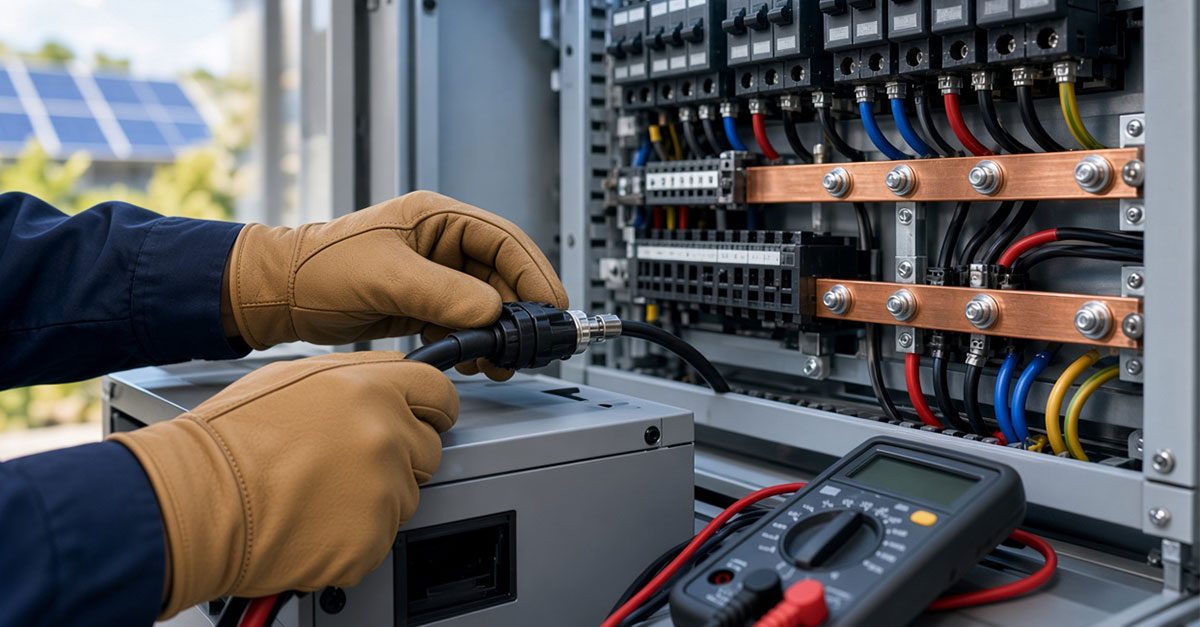
The newly published 2026 NEC adds a genuinely useful tool for exactly the panels where 705.12’s math runs out of room, though it will take most AHJs a code cycle or two to formally adopt it, so treat this as “know it’s coming” rather than “usable on tomorrow’s permit.” Section 705.13 introduces multisource Power Control Systems (PCS), which must be UL 3141 listed and, per the monitoring and control requirements in Article 130 Part II, actively limit current on a busbar or conductor in real time rather than relying solely on the passive, worst-case assumptions built into the 120% rule (pv magazine USA).
The provision applies specifically to multisource configurations, such as a combined PV-plus-storage interconnection, and control settings are restricted to qualified persons, meaning a licensed electrician or engineer, not the homeowner or facility staff. For a commercial retrofit where the existing panelboard is already maxed out on paper but rarely near capacity in practice, a PCS can eventually make an interconnection code-compliant without a service upgrade. It doesn’t replace 705.12, it sits alongside it as a smarter, more instrumentation-heavy option for tight panels once your jurisdiction is on the 2026 cycle.
It’s worth noting that this kind of load-side interconnection framework isn’t unique to the U.S. In the UK, grid-connected storage and generation above certain thresholds must meet G99 requirements rather than NEC rules; we walk through that comparison in Battery Energy Storage Systems G99 Certification: Understanding G99 Compliance for the UK. The underlying goal in both frameworks is the same: make sure a distributed power source can’t overload equipment that was never sized to see current flowing in more than one direction. Code compliance and product safety certification tend to travel together, and it’s a good idea to review a system’s UL listings (UL 9540A for thermal runaway propagation, UL 1973 for the battery itself) at the same time as the interconnection plan, something we cover in more detail in our MEGATRON UL 9540A and UL 1973 certification overview.
What NEC 705.12 Means for Your Next Project

Two things are true at once heading into the rest of 2026. First, the economic case for storage keeps strengthening, especially at commercial scale where the 48E credit still has years of runway and demand charges make dispatchable storage a straightforward payback calculation. Second, the code path for getting that storage connected has gotten more nuanced, not less, with the 120% rule still doing most of the work today and a new PCS option on the horizon, once your jurisdiction adopts the 2026 NEC, for panels that can’t otherwise fit the math. Getting the NEC 705.12 interconnection plan right early, before conductor sizes and panel locations are locked in, remains the single best way to avoid a change order once the electrical inspector shows up. If you’re weighing on-grid, off-grid, or hybrid configurations for an upcoming project, our overview of the differences between on-grid, off-grid, and hybrid battery energy storage systems is a good next read.