
A battery energy storage system is only as safe as its weakest layer. Cells get most of the attention, but a complete BESS is cells, modules, a battery management system, a power conversion system (PCS), thermal management, protection gear, and a fire strategy, all working as one product. This guide explains how BESS fire safety actually works in 2026: what thermal runaway is, what the failure data says, which standards matter (NFPA 855, UL 9540, UL 9540A, IEC 62933-5-2), and the questions every buyer should ask before purchasing.
The short version: industry-wide, EPRI reports a 98% drop in failures per deployed GWh between 2018 and 2025. Modern LFP systems with an integrated PCS, tested to UL 9540A and listed to UL 9540, build on the practices behind that trend, but an industry-wide statistic does not show that any one design is safe. Much of the remaining risk comes from how engineers design, installers commission, and operators maintain the system, not from the chemistry alone.
Thermal Runaway: The Core of BESS Fire Safety
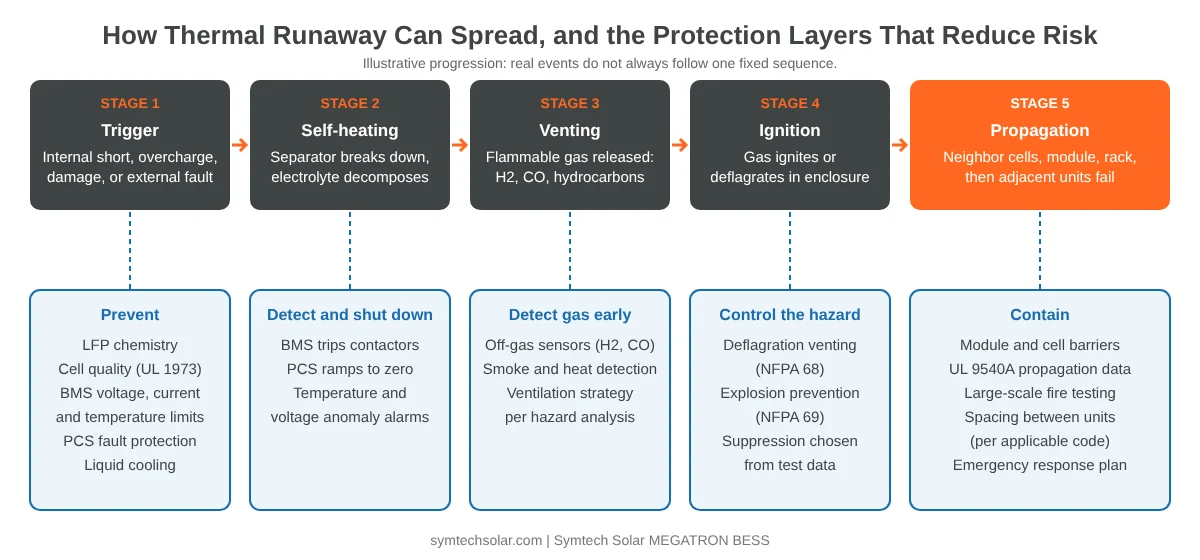
Thermal runaway is a self-reinforcing chain reaction inside a lithium-ion cell. Heat from an internal short, overcharge, mechanical damage, or an external fault raises the cell temperature. At a critical point the separator breaks down, the electrolyte decomposes, and the cell releases more heat than it can shed. It then vents flammable gas (hydrogen, carbon monoxide, hydrocarbons) and can ignite neighboring cells. Specifically, a major hazard is propagation, meaning one failed cell taking the module, the rack, and the enclosure with it. Therefore, almost everything in BESS fire safety comes down to stopping that chain early, or stopping it from spreading.
LFP Reduces the Risk but Does Not Remove It
Lithium iron phosphate (LFP) cells have a higher thermal runaway onset temperature than nickel-based chemistries (NMC and NCA), generally release less heat under comparable conditions, and release oxygen less readily from the cathode. That makes LFP a strong foundation. However, a failing LFP cell still vents flammable gas, and that gas is a major hazard at system level. If vented gas accumulates inside an enclosure and finds an ignition source, the result can be a deflagration rather than a simple fire. For that reason, gas detection, ventilation, and explosion control matter as much as suppression.
BESS Fire Safety Data: What EPRI Failure Statistics Show
EPRI’s BESS failure incident database is a publicly available industry incident database. Its latest analysis, Risk Factors and Failure Statistics of Lithium-Ion BESS (October 2026), reports that annual failures per deployed GWh fell 98% between 2018 and 2025, even as the world installed over 300 GWh in 2025 alone. Overall, about 93% of the incidents in its database caused no reported injuries or fatalities, and EPRI reports none spreading fire beyond the facility perimeter, which does not rule out off-site smoke, evacuations, or environmental impacts. EPRI also found that indoor facilities are overrepresented in failures and suffer more damage, and that failure rates have been lower for newer vintages, which is an observed fleet trend rather than a guarantee that batteries get safer with age. However, it could not isolate cell chemistry as a standalone cause of system-level failure.
Lessons From Moss Landing and McMicken
The Moss Landing fire in January 2025 is the case everyone remembers. It involved a 300 MW legacy installation using NMC cells, housed indoors in a repurposed turbine hall that predates NFPA 855. WECC’s December 2025 operations analysis did not determine a root cause, but it noted that NMC is more prone to thermal runaway than LFP and that the overhead sprinklers were switched off during the fire because they were proving ineffective. In short, it is an argument for modern design, not against storage: today’s mainstream designs use LFP cells in separated, outdoor, purpose-built enclosures with tested propagation behavior. For more on how chemistry and design choices play out, see our guides to commercial lithium-ion battery systems and 280Ah LFP cells.
Moss Landing, however, is not the only lesson. In April 2019, an explosion at the McMicken energy storage facility in Surprise, Arizona injured firefighters; the FSRI report counts four seriously injured. A commissioned investigation concluded that a cascading thermal runaway event began with an internal cell defect. It also found that the fire suppression system worked as designed, but only for ordinary fires. That case is why modern codes focus on gas detection, ventilation, and explosion control, not just suppression.
Why the PCS Matters for BESS Fire Safety
Fire safety discussions often stop at the battery. However, in a real system, the PCS is a high-power electrical device sitting right next to the DC bus, and it is a legitimate ignition source if it fails. For example, DC arc faults, failed capacitors, damaged power semiconductors, loose terminations, and welded contactors can all start a fire that has nothing to do with cell chemistry. That is why the system boundary matters.
When the PCS is integrated (AC power output) with the battery system, engineers can design the protection scheme as a whole:
- One coordinated fault response. The BMS, PCS, and protection devices share trip logic. If the BMS flags a cell fault, the PCS can ramp to zero and open the DC contactors in a defined sequence, instead of two vendors’ controls guessing at each other.
- DC-side protection sized for the real fault current. Engineers match fuses, breakers, insulation monitoring, and ground-fault detection to the actual battery and converter, not to a generic spec sheet.
- Certification of the complete assembled system. UL 9540 evaluates the energy storage system as a complete product, including power conversion and controls. Separately housed, matched components can form a certified complete system when the certification covers the assembled configuration, so ask what the certificate covers rather than how many enclosures or manufacturers are involved. Parts that are each certified on their own, without a certificate for the combination, leave interface risk that no single listing covers.
- Fewer field connections. Factory-built, factory-tested wiring (see our FAT and SAT testing overview) reduces the risk of loose-lug and mis-crimp errors, a common cause of site faults.
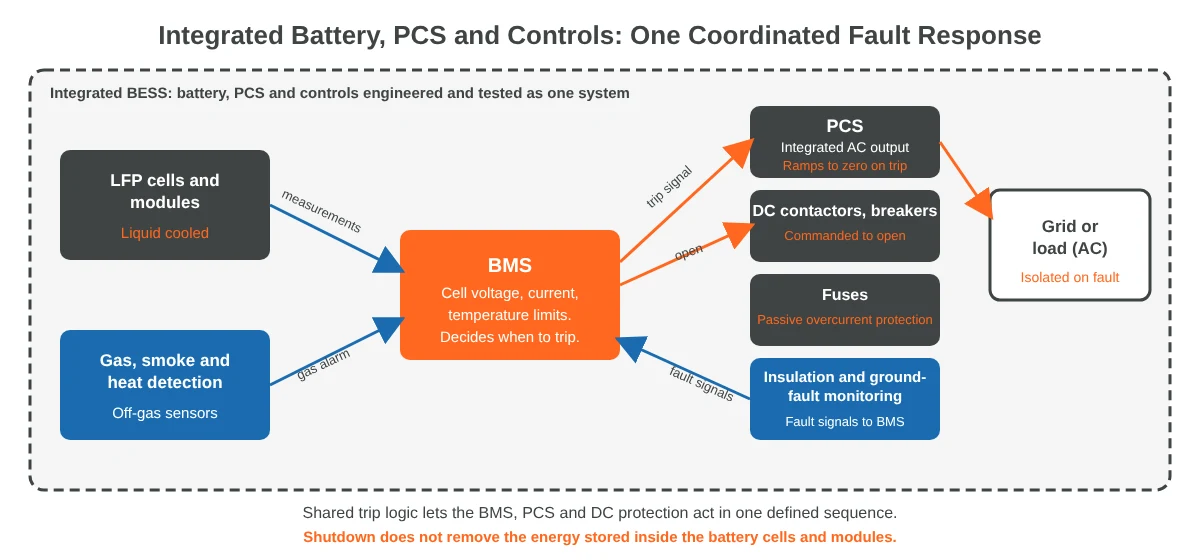
For that reason, our MEGATRON systems ship with the PCS integrated. Our post on BMS vs. SCADA vs. EMS covers the control layers that tie it together, and our BMS deep dive goes further.
BESS Fire Safety Standards: Who Tests What
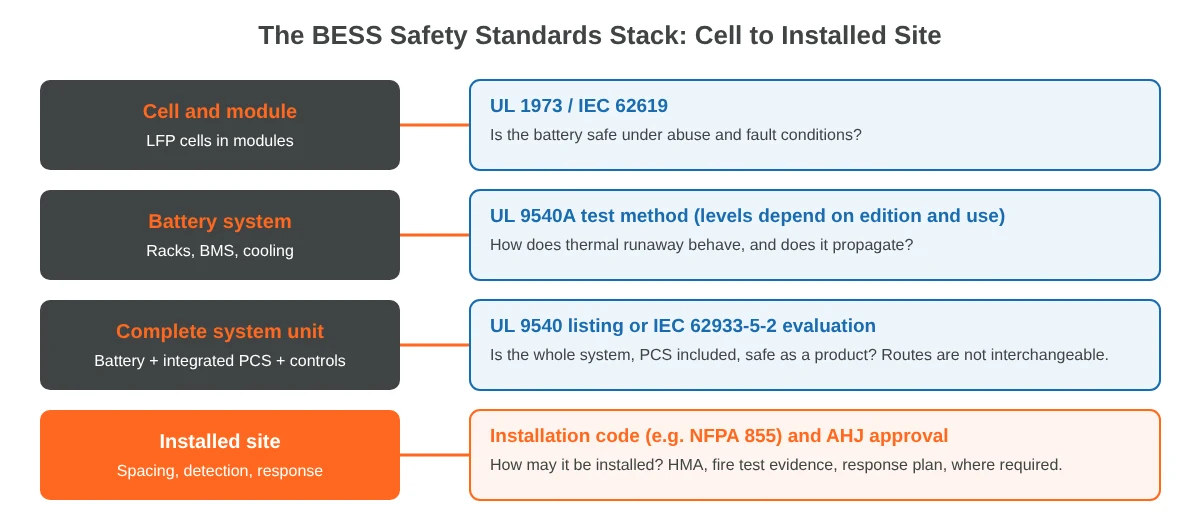
BESS fire safety standards stack in layers, from the cell up to the installed site. Each one answers a different question.
| Standard | Level | What it answers |
|---|---|---|
| UL 1973 / IEC 62619 | Cell, module, battery | Is the battery itself safe under abuse and fault conditions? |
| UL 9540 | Complete system | Is the whole ESS, including PCS and controls, safe as a product? |
| UL 9540A | Cell, module, unit, installation | What happens during thermal runaway? Does it propagate, and how much gas and heat results? |
| IEC 62933-5-2 | Grid-integrated system | International safety requirements for electrochemical storage systems. |
| NFPA 855 | Installation | Where and how can the system be installed: spacing, detection, suppression, emergency response? |
Two common misunderstandings are worth clearing up. First, UL 9540A is a test method, not a system listing. It generates data on gas, heat, and propagation that fire engineers use to design the site, and recent editions add pass/fail criteria at specific test levels. Second, a UL 9540 listing and a UL 9540A test report are different documents, and a serious supplier should be able to provide both. The fifth edition of UL 9540A (March 2025) tightened definitions of thermal runaway propagation and refined measurement and reporting at each test level. The sixth edition (March 2026) adds system-level large-scale fire testing with pass/fail criteria, and UL identifies January 1, 2027 as its effective date. Fifth-edition reports are not automatically unacceptable, so ask which edition, test levels, exact configuration, and results a report covers, and confirm that your authority accepts it.
NFPA 855 (2026 Edition): What Changed for BESS Fire Safety
NFPA 855 is the installation code most U.S. authorities reference. Importantly, published summaries describe the 2026 edition as raising the bar in several places. This summary does not replace the code, so confirm each item against the edition your authority adopts, because applicability depends on the system:
- Hazard mitigation analysis (HMA) and fire test evidence may be required, depending on the system and the edition your authority adopts.
- Large-scale fire testing may be required in addition to UL 9540A data, where the adopted code and approval conditions call for it, to show whether a fire in one unit spreads to an adjacent unit.
- Emergency response plans are generally expected, with content, review and training requirements set by the adopted code and your authority.
- Alternate suppression may be accepted where fire testing and an HMA support it, while sprinkler requirements remain where they apply.
- Early detection is generally expected, with the method set by the system design, the adopted code and your authority.
However, local adoption lags the national code, so always confirm which edition your authority having jurisdiction (AHJ) enforces.
Fire Safety Requirements by Market
NFPA 855 and UL 9540A dominate the U.S. conversation, but we ship globally, and the compliance path changes with the destination. Specifying the wrong certification set is one of the most common causes of project delay, so settle it at the quotation stage, not after the order. Our BESS models carry different certifications: not every unit is UL certified, and the certification route differs by model and destination market. Certification is model-specific, so ask us for the current certificates covering the exact model and configuration you are buying.
Compliance Path: North America, Europe, and the UK
| Market | System and battery safety | Installation and fire code | Fire test evidence | Our matching product |
|---|---|---|---|---|
| USA | UL 9540 (system), UL 1973 (battery), UL 1741 (inverter interface) | NFPA 855, International Fire Code ch. 12, NEC Art. 480/706; local AHJ approval | UL 9540A, plus large-scale fire testing where required by the adopted code and approval conditions | Models with UL certification; not all models carry it, so confirm the certificate for the exact model |
| Canada | ANSI/CAN/UL 9540 certification or another approval route accepted by the relevant authority | Applicable provincial or territorial electrical, building and fire requirements, including the adopted Canadian Electrical Code and National Fire Code of Canada; local approvals | ANSI/CAN/UL 9540A reports and any additional evidence the authority requires | Models with UL certification where applicable; confirm Canadian marking requirements for the exact model |
| European Union | CE marking; IEC 62619 (batteries), IEC 62933-5-2 (grid-integrated storage); EU Battery Regulation | National codes and local fire services, for example VdS 3103 guidance in Germany; insurer requirements are often decisive | Insurers frequently accept UL 9540A data; some require project-specific testing | Models certified to IEC standards; certificates are model-specific |
| United Kingdom | IEC 62619, IEC 62933-5-2; grid connection under ENA G98/G99 | NFCC guidance on grid-scale BESS; planning authority and fire service consultation | Fire test data, ventilation and gas strategy reviewed at planning stage | Models certified to IEC standards, scalable by paralleling units; certificates are model-specific |
Compliance Path: Asia-Pacific and Emerging Markets
| Market | System and battery safety | Installation and fire code | Fire test evidence | Our matching product |
|---|---|---|---|---|
| Asia-Pacific | China: GB/T 36276 and related GB standards. Australia/NZ: AS/NZS 5139 for smaller systems. Japan and Korea: national schemes | China: GB/T 51048-2025 for storage station design (it replaced GB 51048-2014 on 1 April 2026). Australia: state fire rules and Clean Energy Council guidance | Accepted evidence varies; IEC and UL data are commonly referenced | MEG range, configured per country |
| Africa, Middle East, South Asia, Latin America | Mostly IEC-based (IEC 62619, IEC 62933-5-2); local grid codes such as NRS 097 in South Africa | Varies widely by country and jurisdiction, so lenders, insurers and EPCs often set the bar | UL 9540A or IEC-aligned test data is usually the benchmark financiers ask for | MEG range; certification differs by model, so confirm the certificate for the one you choose |
Rule of Thumb for BESS Fire Safety Compliance
An emerging-market codebook may not require a fire test report, but your insurer or project lender may require test evidence. Ask before you sign, not after the container arrives.
Mobile and Trailer-Mounted BESS Fire Safety
In addition, mobile and trailer-mounted systems add their own considerations: UN 38.3 transport testing for the cells and transport requirements for the complete battery or system configuration, vibration and shock robustness, and temporary-site fire access. A mobile unit parked near buildings or vehicles may also lack the separation a fixed site would have, which changes how a fire authority views it.
Layers of BESS Fire Safety Protection
No single device delivers BESS fire safety. Good designs stack independent layers so that one failure does not become an incident:
- Chemistry. LFP cells have a higher thermal runaway onset temperature and generally release less energy than NMC under comparable conditions.
- Cell and module design. Venting paths, cell spacing, and barriers slow or stop propagation.
- BMS. Monitors cell voltage, temperature, and current, and takes configured protective actions, such as opening contactors, when limits are exceeded. See our BMS, SCADA, and EMS guide.
- Thermal management. Even temperature across cells also keeps degradation and hot spots down; liquid cooling can do this better than air, depending on design and operating conditions.
- PCS and electrical protection. Integrated DC fusing, arc and ground-fault detection, and coordinated trip logic with the BMS.
- Detection. Off-gas (hydrogen, carbon monoxide), smoke, and heat sensors can give earlier warning than smoke detection in some failure scenarios. Catching vent gas early gives the BMS and PCS a chance to shut the system down, which may reduce the risk of escalation but cannot guarantee that a fire is prevented.
- Ventilation and explosion control. Vent gas that collects inside an enclosure can deflagrate. Deflagration venting (NFPA 68) or explosion prevention (NFPA 69) addresses this; ordinary exhaust ventilation is not automatically adequate explosion control.
- Suppression. Test data decides the agent type and delivery method. Water cools the surrounding cells, and some designs provide an external water connection for this purpose; gaseous agents can extinguish flame but do not stop thermal runaway on their own.
Site-Level Protection Layers
- Siting and spacing. Separation between containers, setbacks from buildings, and access for responders, that the applicable code and the AHJ require.
- Emergency response plan. Trained responders and a documented plan, including the common strategy of letting a contained unit burn out while protecting exposures. Our containerized BESS guide covers how enclosure design supports this.
Detection and Response: Why Seconds Matter for BESS Fire Safety
Smoke detectors alone may be too slow for battery systems. A cell in early failure can emit gas before it produces smoke or visible flame, so off-gas detection can give earlier warning in some failure scenarios and complements other detection. Best-practice designs therefore add off-gas detection (hydrogen and carbon monoxide are the usual targets) alongside temperature and smoke sensing. The signal feeds the BMS and the system controller, which can act automatically under a validated, system-specific fire and gas control strategy, for example by stopping charge and discharge, opening contactors, and raising the alarm; any ventilation response depends on the design and the hazard analysis. Where several sensor types vote before the controller escalates, the logic must balance false-alarm reduction against response time and be validated.
Likewise, suppression needs the same careful thinking. Clean agents and aerosols can knock down flames, but they do not cool a cell that is already in runaway. Water-based systems do cool, but they add their own design considerations around electrical equipment. The suppression choice therefore depends on the enclosure design, the test data, and the local fire authority, and engineers always pair it with detection and venting rather than using it alone.
Water-Based Fire Control: External Water Connections and Flooding
Some BESS designs include an external water pipe connection, which lets responders or a site water supply feed water into the enclosure. Whether a connection is available for a given model, and what it is designed to support, must be confirmed with the manufacturer. The Hartford notes that some BESS units use this approach: a pre-piped system with a connection on the exterior that lets firefighters supply water without opening the container. Water matters because it removes heat. Clean agents can knock down flames, but do not cool cells, while water is an effective cooling medium that can help slow propagation to neighboring modules. A connection on the enclosure does not, by itself, mean the unit is designed for flooding, so confirm the water application guidance for the specific model.
Trade-Offs of Water-Based Protection
Water is not a simple fix, though, and the design has to account for its trade-offs:
- Shutdown reduces hazards but does not de-energize the battery. Water on energized DC equipment can cause arcing and short circuits. Opening the contactors and isolating the PCS reduces some electrical hazards, but stored energy remains in the cells and modules, so shock hazards and delayed reignition remain possible. Water application should follow the equipment-specific emergency response plan and fire service direction.
- Application strategy is system-specific. pv magazine describes using a fog pattern to cool adjacent modules in some designs, rather than spraying the initiating battery directly. The right approach depends on the equipment and the incident.
- Supply and runoff need planning. Flooding takes a reliable water supply at the right flow and duration, plus drainage or containment for contaminated runoff.
- Water works with gas control, not instead of it. Water cools cells, but it does not remove flammable vent gas, so detection and ventilation still matter.
- The fire service must know the plan. The connection location, flow rate, and shutdown steps belong in the emergency response plan that NFPA 855 now requires.
The Moss Landing Phase 1 system had a water-based mitigation system and overhead sprinklers, yet WECC’s Moss Landing report found that operators switched the sprinklers off during the fire because they were proving ineffective. In addition, WECC recommended against default reliance on overhead sprinklers in warehouse-style BESS. Overall, the lesson is that engineers must design water-based protection around the specific enclosure and back it with test data.
Site Design: Spacing and Access for BESS Fire Safety
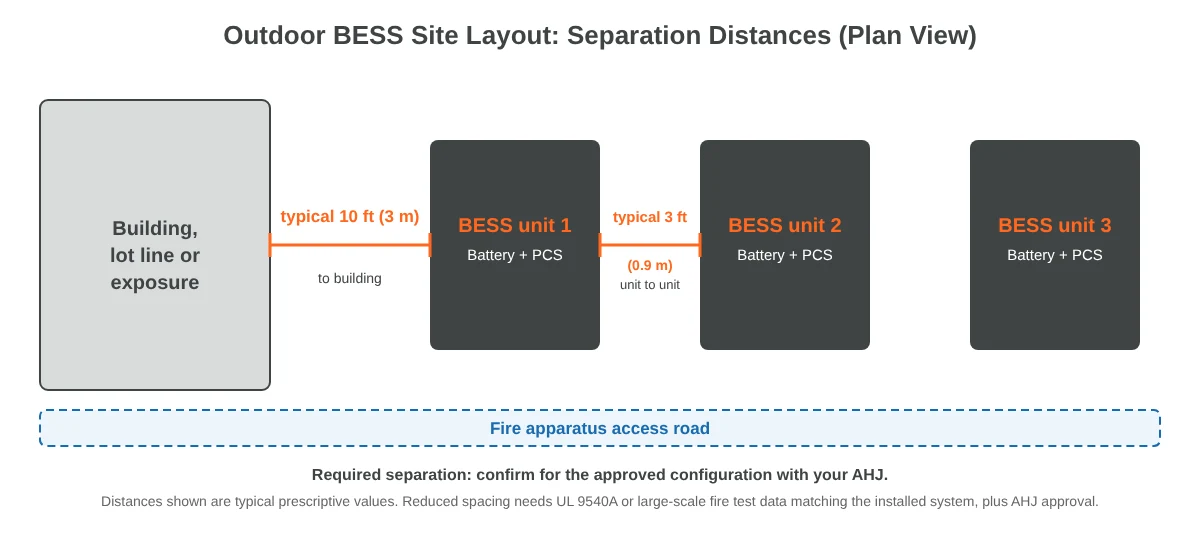
Still, even a well-protected system needs space around it. In many U.S. jurisdictions, NFPA 855 sets the baseline, and similar principles guide projects elsewhere, but the governing code depends on the country and the local authority. Typical prescriptive distances are about 3 ft (0.9 m) between outdoor units and about 10 ft (3 m) from buildings and other exposures, plus clear access for fire apparatus. Check the adopted code, because these distances can be enforceable minimums unless an approved alternative applies. Reduced spacing needs UL 9540A or large-scale fire test data that matches the installed system exactly, and the local authority must approve it.
Emergency Response Planning for BESS Fire Safety
A good plan turns the hardware into a safe response. The adopted code and your authority set the plan requirements. In practice, the plan should name who commands the incident and who calls the fire service. It should also list the shutdown and isolation steps, the location of detection panels and any external water connection, the gas and exhaust conditions responders should expect, and the contacts for the manufacturer and the site operator. Because shutdown does not remove stored energy, the plan should say so plainly. Finally, run drills with the local fire service so they know the layout before an incident, not during one.
11 BESS Fire Safety Questions Every Buyer Should Ask
- Does UL 9540 list the complete system, including the PCS, or only the battery?
- Can you share the UL 9540A reports at cell, module, and unit level, and the test edition, levels completed, tested configuration, and results?
- Is there large-scale fire test data showing no propagation between adjacent units?
- What gas detection do you fit, and what do the BMS and PCS do when it triggers?
- How is explosion hazard handled: deflagration venting (NFPA 68), explosion prevention (NFPA 69), or both?
- Which suppression approach do you use (external water connection, clean agent, or both), and what testing backs it up?
- Does the unit have an external water connection, and what flow rate and duration does the design assume?
- What are the required spacing and setback distances for my site?
- Who supplies the hazard mitigation analysis and emergency response plan inputs?
- What do you test at the factory (FAT) before shipping, and what do you repeat on site (SAT)?
- What are the shipping classification and transport documents for the complete battery and system configuration? See our LFP shipping classifications guide.
Frequently Asked Questions
Are LFP batteries safer than NMC?
Generally yes at the cell level: LFP has a higher thermal runaway onset temperature and generally lower heat release, which is why it dominates stationary storage. But LFP cells can still fail and vent flammable gas, so system-level protection is still required. EPRI could not attribute system-level failures to chemistry alone.
Does a UL 9540A report mean the system is certified?
No. UL 9540A is a test method that produces data, with pass/fail criteria at some test levels in recent editions. It is not a system listing. The system listing is UL 9540, and installation approval comes from the AHJ under codes such as NFPA 855. Check the edition, test levels, and tested configuration.
Can a BESS be installed indoors?
Sometimes, with stricter limits on size, separation, detection, and suppression. EPRI data shows indoor facilities are overrepresented in failures, so outdoor, purpose-built enclosures are the usual choice for larger systems.
Are BESS a fire risk?
Yes, as with any lithium-ion system, but a system that engineers design, test, install, and maintain properly fails rarely. EPRI reports a 98% drop in failures per deployed GWh between 2018 and 2025, and about 93% of the incidents in its database caused no reported injuries or fatalities.
What causes BESS fires?
Most serious BESS fires trace back to thermal runaway. For example, overcharge, an internal cell defect, a short circuit, mechanical damage, or a failed cooling path can trigger it. In addition, electrical faults in the PCS or DC wiring, such as arc faults and loose terminations, can start a fire that has nothing to do with the cells.
What does BESS stand for, and how do firefighters treat it?
BESS stands for battery energy storage system. Firefighters treat it as energized equipment that may vent flammable gas, so responders need the equipment-specific plan, the gas conditions, and the shutdown status before they act. However, shutdown does not remove stored energy from the cells, which is why the emergency response plan and clear signage matter.
What is BESS safety?
BESS safety is the combination of cell quality, BMS and electrical protection, thermal management, gas detection, venting, suppression, site spacing, and emergency planning. Together, these layers keep a system from failing and limit the harm if it does.
Can a BESS be flooded with water in a fire?
Not by default. Some designs include an external water connection that lets responders or a site supply feed water into the enclosure to cool cells and slow propagation. However, an external connection does not by itself mean an enclosure is designed for flooding. Shutdown reduces electrical hazards but does not remove stored energy from the cells, so water application must follow the equipment-specific emergency response plan and fire service direction, and the site needs a reliable water supply and a plan for runoff.
Why does the PCS matter for BESS fire safety?
The PCS handles high DC and AC power next to the battery, so it can be an ignition source in its own right. Therefore, an integrated PCS lets the manufacturer design, test, and list the protection scheme as one system.
Final Thoughts on BESS Fire Safety
BESS fire safety is a system property. In practice, choose LFP, confirm certification of the complete system for the destination market, including UL 9540 where required, ask for UL 9540A and large-scale fire test data, and design the site to the code edition your AHJ enforces, such as NFPA 855 in many U.S. jurisdictions. MEGATRON systems from Symtech Solar are supplied with an integrated PCS, so the battery, converter, and protection scheme are engineered as one product. Finally, explore Symtech Solar’s BESS product line or send us your country, site type, and target capacity at [email protected]. We match the certification path to your market from the first quotation. Certifications differ by model, so we tell you up front which certificates apply to the unit you are considering.
This article is general technical information, not engineering or legal advice. Codes change and local authorities have final say, so confirm requirements with the authority having jurisdiction before design.
Where to Find BESS Fire Safety Rules for Your Market
Codes change, and the local authority always has the final say. Start with these primary sources, then confirm the adopted edition with the authority having jurisdiction (AHJ), your insurer, and your lender.
Standards and Code Sources by Market
Sources
- Energy-Storage.News: Global BESS failure rates declined 98% between 2018 and 2025 (EPRI)
- Energy-Storage.News: NFPA 855, 2026 edition updates
- EPRI BESS Failure Incident Database
- WECC: Moss Landing BESS Fire Report, Operations Analysis (December 2025)
- Manufacturing.net: Thermal runaway likely caused explosion at Arizona battery facility (McMicken)
- The Hartford: Battery energy storage systems (BESS) fire prevention
- pv magazine USA: Water isn’t always the best answer to BESS fires
- Canary Media: Why we do not need to worry too much about the latest grid battery fire
- UL Solutions: Large-Scale Fire Testing and UL 9540A
- NFPA 855: Standard for the Installation of Stationary Energy Storage Systems
- UL: Understanding UL 9540A and NFPA 855
Disclaimer: This article is for general information only and is not engineering, legal, or safety advice. Standards, codes, and certification requirements vary by jurisdiction and change over time, so confirm them with your authority having jurisdiction, insurer, and lender. Product features, options, and certifications differ by model; request current certificates and specifications from Symtech Solar for the exact model and configuration you are considering. Third-party links are provided for reference and do not imply endorsement.