
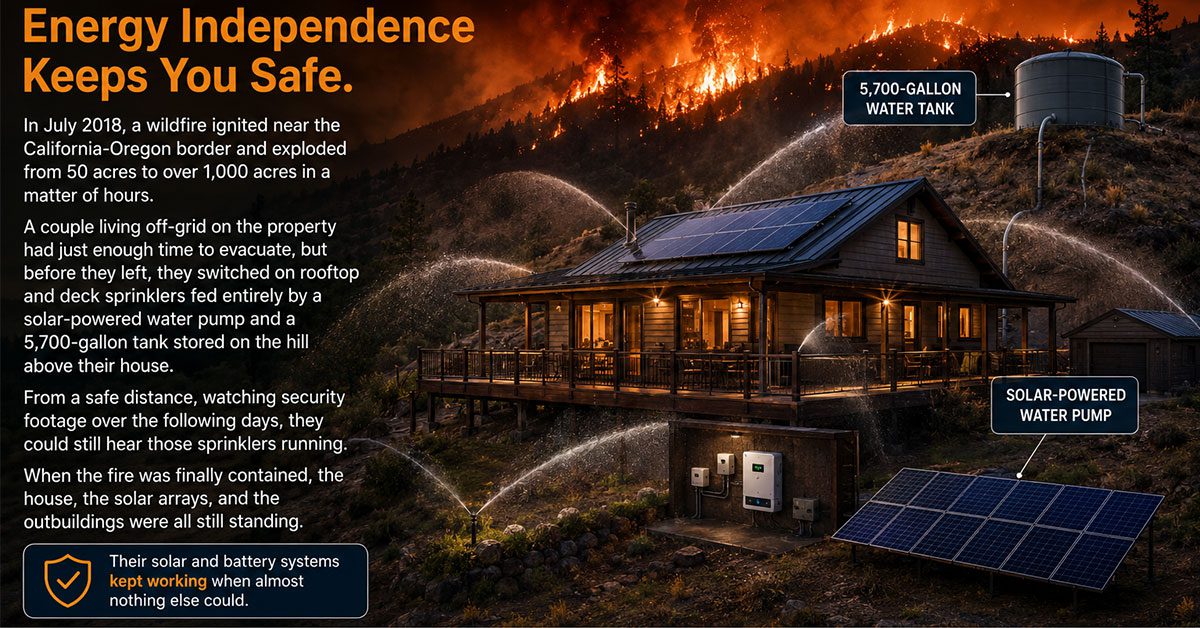
In July 2018, a wildfire ignited near the California-Oregon border and exploded from 50 acres to over 1,000 acres in a matter of hours. A couple living off-grid on the property had just enough time to evacuate, but before they left, they switched on rooftop and deck sprinklers fed entirely by a solar-powered water pump and a 5,700-gallon tank stored on the hill above their house. From a safe distance, watching security footage over the following days, they could still hear those sprinklers running. Their off grid solar & battery storage came through when it mattered most.
When the fire was finally contained, the house, the solar arrays, and the outbuildings were all still standing. It is a dramatic story, but the real lesson is a simple one: their off grid solar & battery storage kept working when almost nothing else could, and that same basic idea (generate your own power, store enough of it, and depend on no one else for it) plays out in homes all over the world, whether the threat is wildfire, a storm, or simply never having had a grid connection to begin with.
What “Off-Grid” Really Means
Living off-grid means producing and storing all of your own power on-site, with no connection to a public utility. It looks different depending on where you are: a cabin in the Canadian bush, a family homestead in rural Kenya, an island house in the Philippines, a remote station in the Australian outback. What ties all of these together is the same basic engineering problem: generate more energy than you need during the day, and store enough of it to get through the night, a run of cloudy weather, and the occasional demand spike.
For most modern off-grid households, solving that problem means pairing solar panels with a battery bank. Panels alone only produce power while the sun is up. Batteries alone need something to charge them. Together, the two form a system that can run a home continuously, day and night, indefinitely, without a single wire back to a utility. If you want a closer look at how off-grid setups compare to grid-tied and hybrid systems, Symtech Solar has a detailed breakdown of on-grid, off-grid, and hybrid battery storage worth reading first.
One important caveat: permitting, water rights, and building codes for off-grid living vary enormously from one country, state, or county to the next. Some jurisdictions welcome off-grid construction; others require a grid connection or specific permits for wells, septic systems, or standalone power. Anyone seriously considering the move should check local regulations early, well before buying land or ordering equipment.
The Building Blocks of an Off Grid solar & Battery Storage System
A typical off grid solar & battery storage system has four core components.
- Solar modules convert sunlight into DC electricity.
- DCDC charge controller regulates how that power flows into the batteries, protecting them from overcharging (modern MPPT controllers are meaningfully more efficient than older PWM designs).
- Inverter converts stored DC power into the AC power that household appliances actually use.
- Battery Bank, technically a Battery Energy Storage System or BESS, holds the surplus energy until it is needed.
That last piece has changed more than any other since the late 2010s. Lead-acid batteries, the old standard for off-grid homes, typically last 300 to 700 charge cycles (roughly 3 to 5 years), need regular watering and maintenance, and can only be safely drained to about 50 percent of their capacity. Lithium iron phosphate (LiFePO4) batteries, which have largely replaced lead-acid in new off-grid installations, commonly last several thousand cycles, run for a decade or more, need essentially no maintenance, and can typically be discharged to 80 percent or more of their rated capacity. They are also safer chemically and more energy-dense, so a lithium bank takes up less space for the same usable storage. For more on how these systems are built and protected, see Symtech’s overview of battery management systems in energy storage.
None of this works as isolated parts, though. Solar panels and batteries function as a pair: panels generate during daylight hours, and batteries bank the surplus so there is power available at night, during storms, and through stretches of overcast weather. Independence from the grid is really independence based on the sun’s schedule, and that only happens when generation and storage are sized to work together. Alternate power sources such as wind and diesel generators can also supplement a BESS when the solar is insufficient or the loads are too great at certain periods.
How to Size an Off Grid Solar & Battery Storage System
Sizing a system correctly is the difference between a home that runs comfortably and one that is constantly rationing power. The process is not complicated, though it does take some homework.
Start by estimating daily energy use. List every appliance you plan to run, note its wattage, and multiply by the hours you expect to use it each day. Add everything up and you get your daily energy need in watt-hours, or kilowatt-hours (kWh) once you divide by 1,000.
Next, factor in peak sun hours for your location, which is the average number of hours per day the sun delivers full intensity (not the same as total daylight hours). This varies significantly by latitude and climate, and it is easy to look up for any location. Divide your daily kWh need by your local peak sun hours to get the rough kW of solar panels required, then add a buffer, commonly 20 to 30 percent, to cover system losses, aging panels, and cloudy days.
Battery sizing depends on how many days of autonomy (backup with no sun at all) you want, and how much of the battery’s total capacity you can actually use. Because lithium batteries tolerate a much deeper discharge than lead-acid, a lithium bank generally needs less total (nameplate) capacity to deliver the same usable storage. Finally, size the inverter for your peak simultaneous load, not just your average load. Many appliances, especially those with motors, draw a brief surge of power well above their running wattage when they start up, and the inverter has to handle that spike.
Running these numbers by hand is a useful exercise, but a sizing tool or an experienced installer removes most of the guesswork. Symtech Solar’s own off-grid load calculator walks through this same process and lets you plug in your own appliance list and location to get a real estimate for your home.
Sizing for Larger Homes and Light Commercial Properties
The same sizing math scales up for bigger homes, farms, and small businesses, with a few extra considerations layered on top. Light commercial properties, a small shop, a farm operation, a restaurant, a rural office, often sit in a middle ground: more demanding than a typical home, but nowhere near the scale of a large industrial facility. These properties can go fully off-grid in remote locations, though it is more common for them to run a hybrid setup that stays connected to the grid day-to-day and switches automatically to solar and battery power, islanding, the moment the grid goes down.
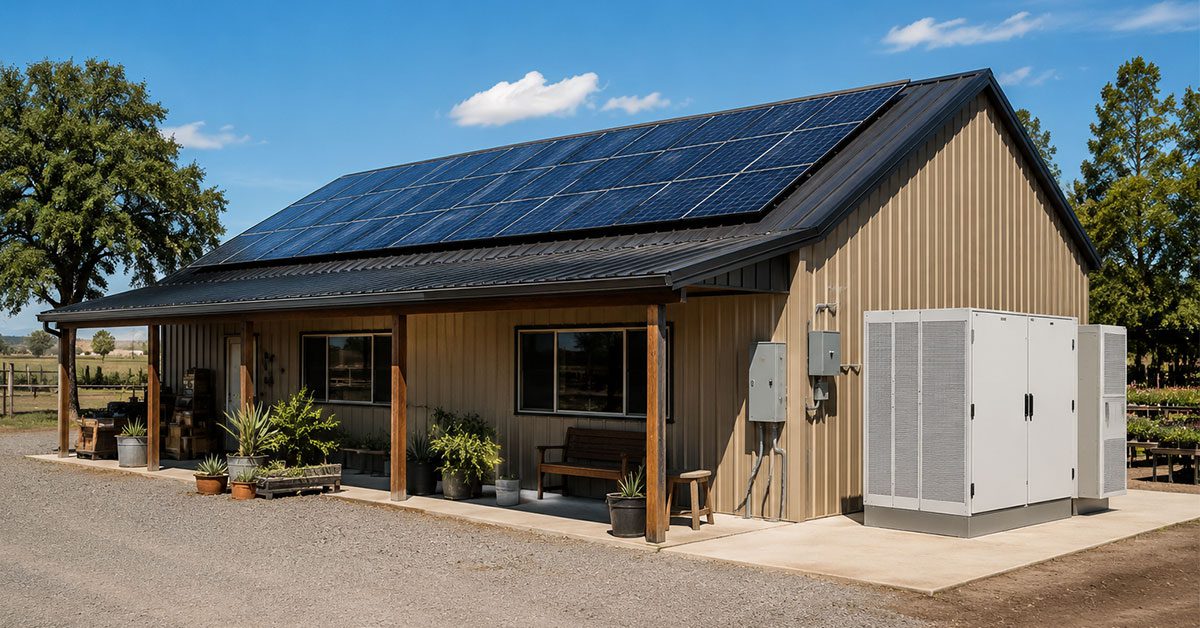
The sizing steps are the same ones used for a home: total daily energy use, peak sun hours, PV array size, battery autonomy, and inverter capacity for peak load. What changes is the scale and the shape of the load. Commercial equipment (walk-in coolers, HVAC units, motors, point-of-sale systems) tends to draw higher and less predictable peak demand than a typical household, so it helps to pull actual utility bills or meter data rather than estimating appliance by appliance. It also helps to separate critical loads, the equipment that has to keep running (refrigeration, communications, basic safety systems) from everything else, so the battery bank is not oversized for loads that can simply wait out a short outage.
At larger scales still, well beyond a home or small business, battery energy storage systems can range from tens of kilowatts up to multiple megawatts, and certifications such as UL 9540, UL 9540A, and IEEE 1547 become part of the conversation for safe grid interconnection. Whatever the scale, Symtech Solar’s off-grid load calculator is a good starting point, and for light commercial or larger projects, Symtech’s team can walk through a full load analysis and engineer a right-sized system; see the business and government solutions page for more.
Businesses That Can’t Afford to Go Dark
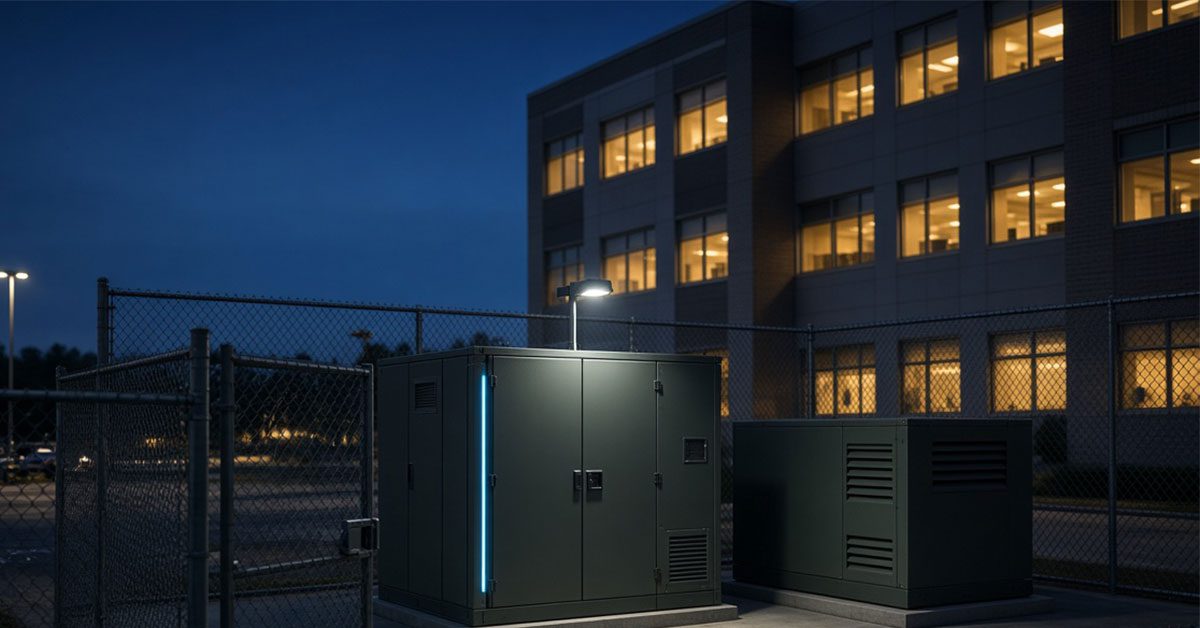
Certain kinds of businesses already treat backup power as non-negotiable. Banks, hospitals, data centers, grocery stores, and gas stations often run diesel generators (DGEN) on standby, or continuously, simply because downtime is not an option. These same facilities are strong candidates for solar-plus-battery adoption: a BESS can shave peak demand charges and cut generator fuel use during normal operation, while still providing instant, silent backup the moment the grid drops, something a generator only delivers after it starts and warms up. For many of these operations, pairing an off grid solar & battery storage system with an existing generator, rather than replacing it outright, is the most practical path, since it reduces runtime and fuel costs while keeping the generator as a deep-reserve backstop.
Water, Backup Power, and Everyday Resilience
Power is only half of off-grid resilience. Water matters just as much, and it depends on power to move. The couple in the wildfire story above owed their house’s survival, in part, to a solar-pumped water system: solar panels ran a pump that filled a 5,700-gallon tank on a hill above the property, and gravity did the rest, keeping sprinklers running even while the power grid and normal infrastructure around them were compromised. A solar water pump paired with a cistern or elevated tank is a common setup for off-grid homes anywhere, not just in fire country. It works just as well for drought-prone regions, storm-prone coastlines, or simply a property with no reliable grid power to run a conventional well pump.
Remote monitoring technology has also become a meaningful part of off-grid resilience. Security cameras, weather stations, and app-based system monitors let homeowners check on a property, and on the status of their solar and battery systems, from anywhere with a signal, even a low-bandwidth one.
Whatever the emergency, whether it is a wildfire, a hurricane, an earthquake, or a grid failure with no dramatic cause at all, the households or businesses that keep functioning are the ones whose critical loads (water pumps, communications, refrigeration, medical equipment) do not depend on outside infrastructure. That is the quiet, practical case for solar-plus-battery independence, disaster or no disaster. Banks, hospitals,
Is Off-Grid Living Right for You?
Off-grid living is not a lifestyle for everyone, and it is worth weighing honestly before committing to it. On the upside, it delivers real independence: no utility bills, no outages tied to someone else’s grid, and often more freedom in where and how you build. Well-designed systems are also increasingly reliable, and the technology has matured enormously in the last several years.
On the other side of the ledger, upfront costs remain significant, often tens of thousands of dollars depending on system size and location, and off-grid systems require ongoing attention. Solar Panels need occasional cleaning, batteries perform best within a certain temperature range, and backup generators or other components need periodic servicing. Off-grid properties are also, by definition, often remote, and that distance from services, neighbors, and emergency response is a real lifestyle trade-off, not just a logistical one. Anyone weighing the move should factor in local permitting and building rules, realistic budget expectations, and an honest sense of how much hands-on maintenance they want to take on.
Looking Ahead
It is worth pausing on how far this technology has come. In 2018, when the wildfire story above took place, lithium batteries were only beginning to show up in off-grid homes, and lead-acid was still the default. Battery storage costs have fallen sharply since then, and lithium systems that were a luxury a few years ago are now the standard recommendation for new installations. The bigger shift, though, is not just about cost. It is that solar-plus-battery independence has gone from a niche, survivalist idea to a practical, everyday option for anyone who wants more control over their own power, wherever in the world they happen to live.
For readers who want to dig deeper, a few outside resources are worth bookmarking. The U.S. Department of Energy’s guide to planning a home renewable energy system is a solid starting point for the basics. NREL’s PVWatts Calculator is a free tool for estimating solar output and peak sun hours anywhere in the world, useful for the sizing math covered above. For a global perspective on off-grid electrification, IRENA’s Off-grid for Energy Access page covers how off-grid renewables are expanding power access worldwide.