
BESS for EV charging is becoming essential as fast chargers pull huge amounts of power in short bursts, spiking utility bills through something called demand charges. The good news: battery energy storage can fix this; with or without solar.
In this article we will discuss the following configurations:
- Grid + BESS — a battery added to your existing power connection.
- Grid + Solar Carport + BESS — a battery paired with solar panels over the parking area (solar carports or canopies).
Below we will discuss how each one works and what benefits it brings.
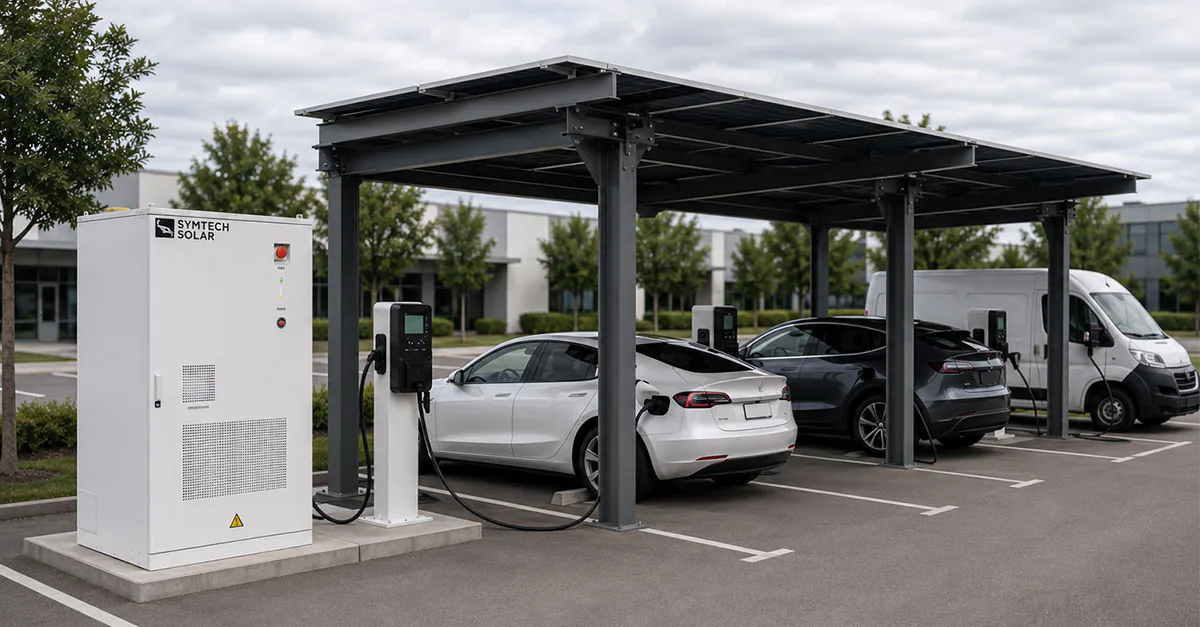
Why EV Charging Sites Benefit by Adding Battery Energy Storage Systems
Most commercial electric bills don’t just charge for how much power is use, they charge extra for the single highest burst of power in a month. That’s a demand charge, and it can be a bigger cost driver than the actual electricity itself. Find more info on demand charges here: DEMAND CHARGES
Fast chargers are especially hard on this. A single DC fast-charging session can pull hundreds of kilowatts in just a few minutes. That one short burst sets your peak demand for the entire billing period—sometimes for the whole year, depending on how your utility structures its rates. Charge one car quickly on a slow week, and you could be paying for that spike every month after.
This challenge isn’t unique to any one utility, either. Demand charges are common across much of the U.S. and Europe, but the specifics vary a lot from one utility to the next. Some charge a flat demand rate year-round; others apply steep seasonal rates that spike higher in winter or summer. Some structure demand charges around time-of-day peaks, while others simply look at your single highest draw all month, regardless of when it happened. The bottom line: the exact savings a battery system delivers depends heavily on how your specific utility bills for demand, so it’s worth understanding your own rate structure before sizing a system.
You can look up your own utility’s rate structure, including demand charges, using the Department of Energy’s free Utility Rate Database.
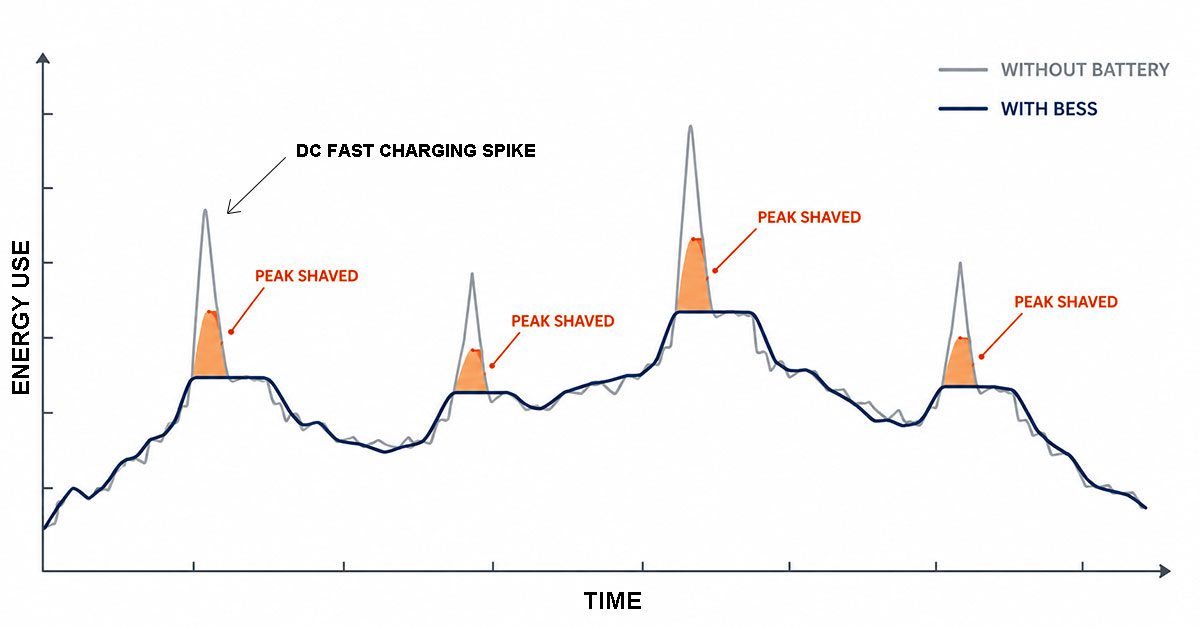
Adding a BESS for EV charging changes that picture. Instead of every charging session pulling directly from the grid, the battery steps in to absorb the spike—discharging its stored power during those short, intense bursts and drawing from the grid more slowly and steadily in between. The result is a flatter, more predictable load profile, which directly translates into lower demand charges.
Beyond the bill itself, batteries unlock a few other practical benefits:
- They let sites support more chargers without expensive electrical upgrades. A utility service upgrade to handle high-power fast charging can cost tens of thousands of dollars and take months of permitting. A properly sized battery can often let a site support that same charging load on its existing service.
- They make charging costs more predictable. Instead of one unpredictable spike setting your rate for the month, the battery keeps demand within a manageable, plannable range.
- They take advantage of cheaper electricity when it’s available. In markets with time-of-use pricing, batteries can charge up during low-cost, off-peak hours and discharge during expensive peak hours—saving money even without solar involved.
- They help sites scale. As more chargers or charging bays get added, a battery keeps the combined demand from those chargers from stacking on top of each other and pushing costs even higher.
Option 1: Grid + BESS (No Solar)
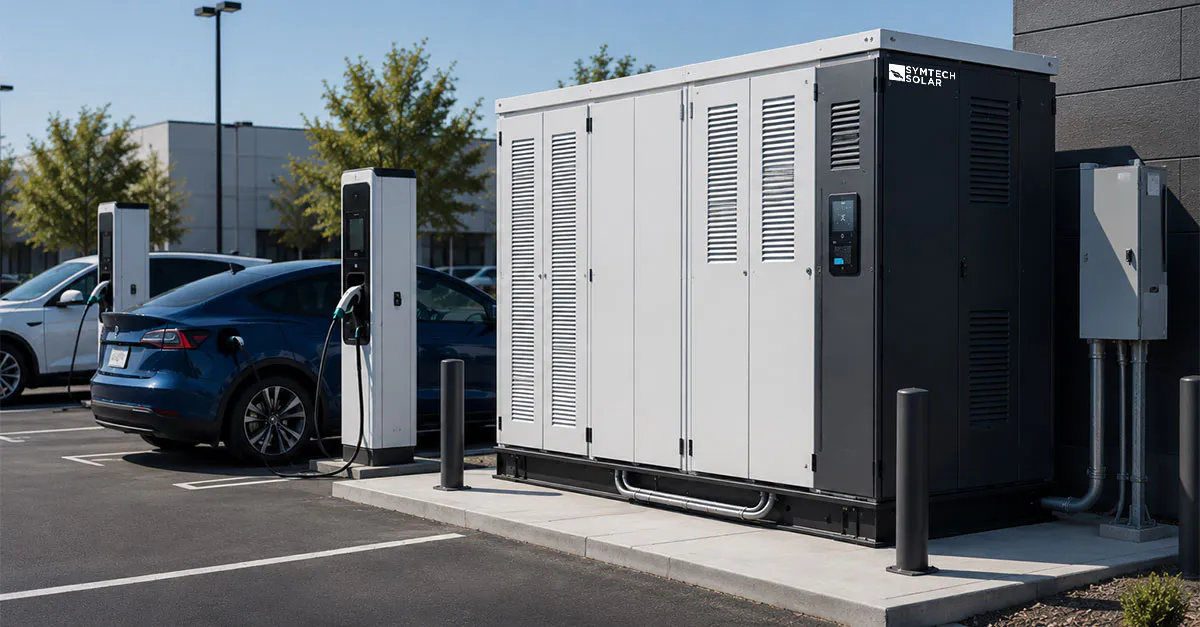
BESS for EV charging. This is a battery connected straight to your existing power line—no solar involved. It’s usually the fastest and cheapest way to start saving.
What it does:
- Cuts your peak demand. The battery discharges during charging spikes so your site never draws too much power from the grid at once.
- Handles multiple chargers at once. It smooths out demand even when several cars are charging at the same time.
- Avoids costly utility upgrades. Many sites can skip a service upgrade that would otherwise cost tens of thousands of dollars and take months.
- Saves on time-of-use rates. The battery can charge up during cheap, off-peak hours and discharge during expensive peak hours.
- Installs fast. No construction, no solar permitting—just the battery system.
This approach works well for sites without room, roof, or budget for solar, or anyone who wants savings up and running quickly.
Option 2: Grid + Solar Carport + BESS
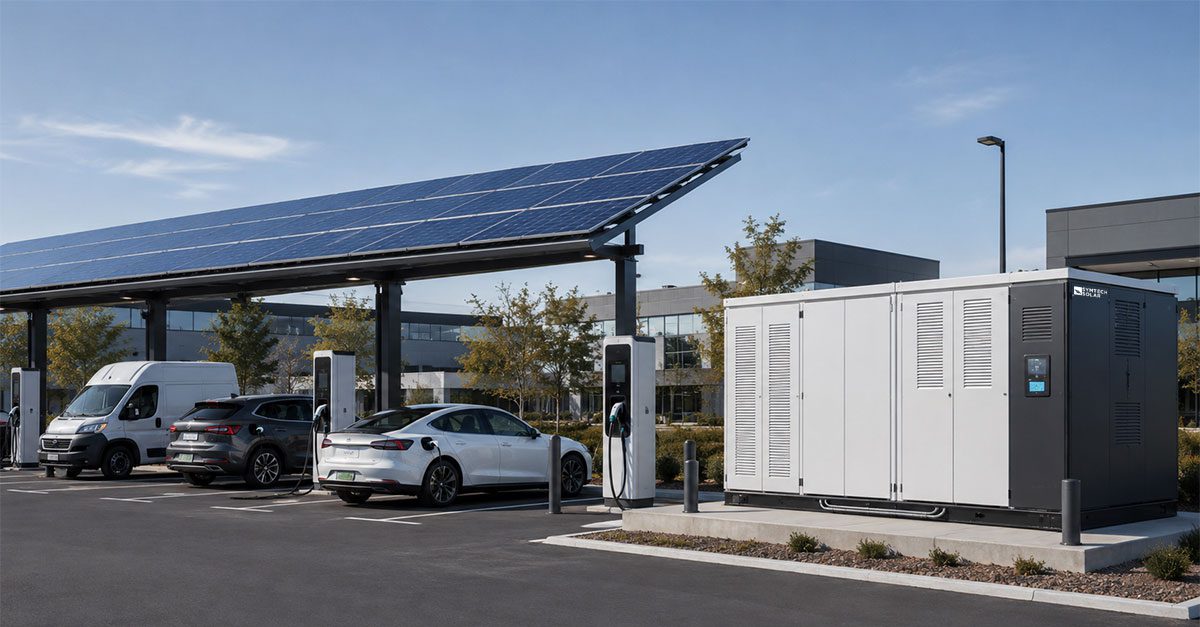
This setup adds solar modules (carport) over the parking area, plus a battery. The carport shades cars and makes electricity; the battery stores it and uses it when it’s needed most.
What it does:
- Stores solar for later. Solar peaks at midday, but charging often peaks morning and evening. The battery bridges that gap.
- Cuts demand charges even more. Some of what the battery discharges came from free solar power, not the grid.
- Avoids grid upgrades too. Solar and storage together often let a site handle fast charging on its existing service.
- Keeps things running in an outage. With the right setup, chargers can stay on even if the grid goes down (hybrid EMS with STS typically required).
- Pays back the solar investment faster. Storing solar power is worth more than selling it back to the grid.
- Adds shade for drivers. A nice perk that also sets a site apart.
This approach works well for sites with suitable parking space and the budget to invest in the strongest long-term savings and added site value.
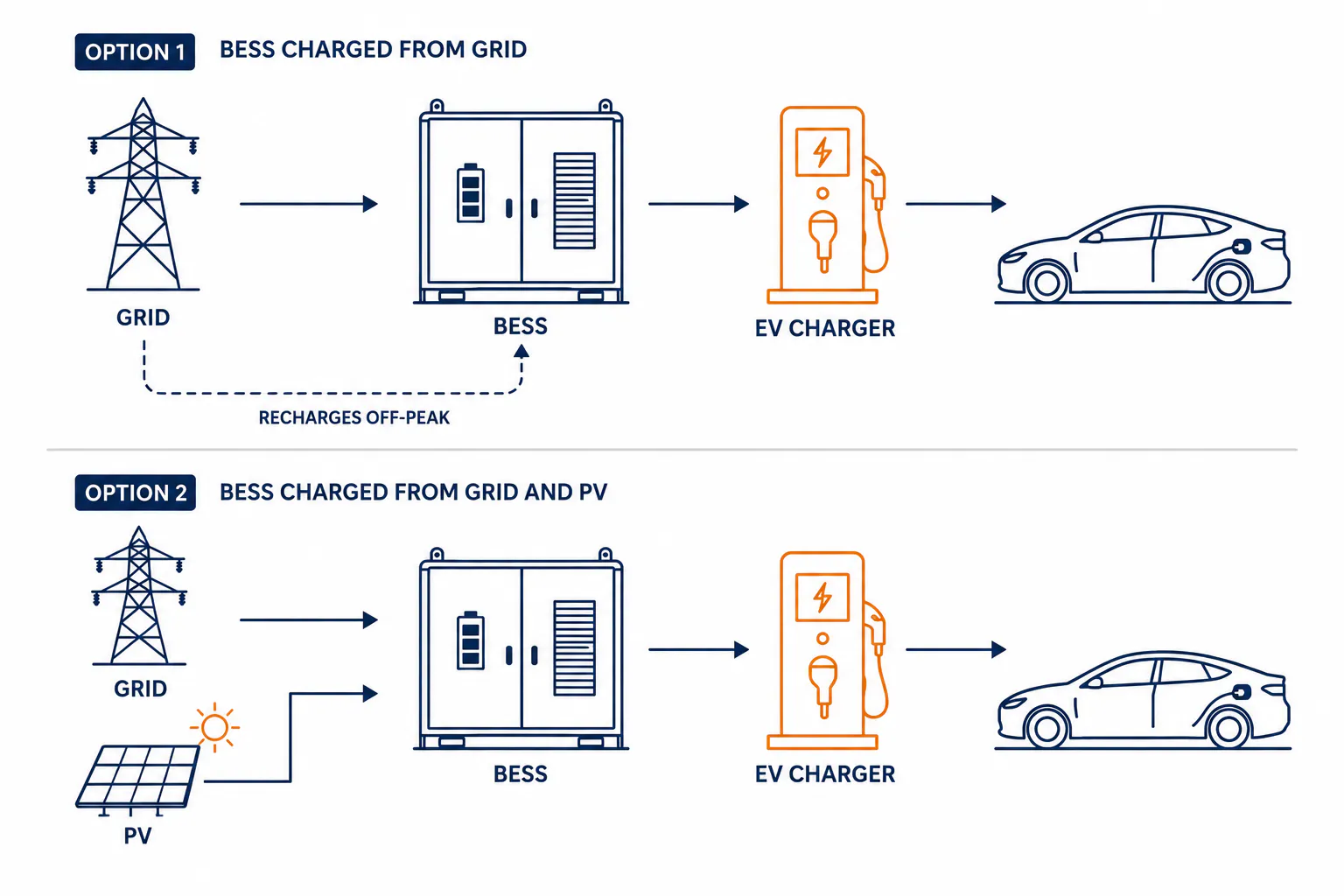
What Each Option Brings to the Table
| Grid + BESS | Grid + Solar Carport + BESS | |
|---|---|---|
| Main benefit | Lower demand charges | Lower demand charges + free solar power |
| Upfront cost | Lower | Higher |
| Site needs | Small footprint, easy retrofit | Space for a carport structure |
| Install time | Faster | Longer (construction + solar permits) |
| Long-term value | Strong | Highest |
A Typical Solar, BESS and EV Charging setup
The diagram below shows how Symtech Solar’s Hercules solar carport and Megatron battery storage system come together into a single integrated EV charging solution. Rather than treating solar generation, battery storage, and vehicle charging as separate systems bolted together, the setup is designed so each component works with the others from the ground up—from the carport structure itself down to the cloud-based monitoring that manages it all.
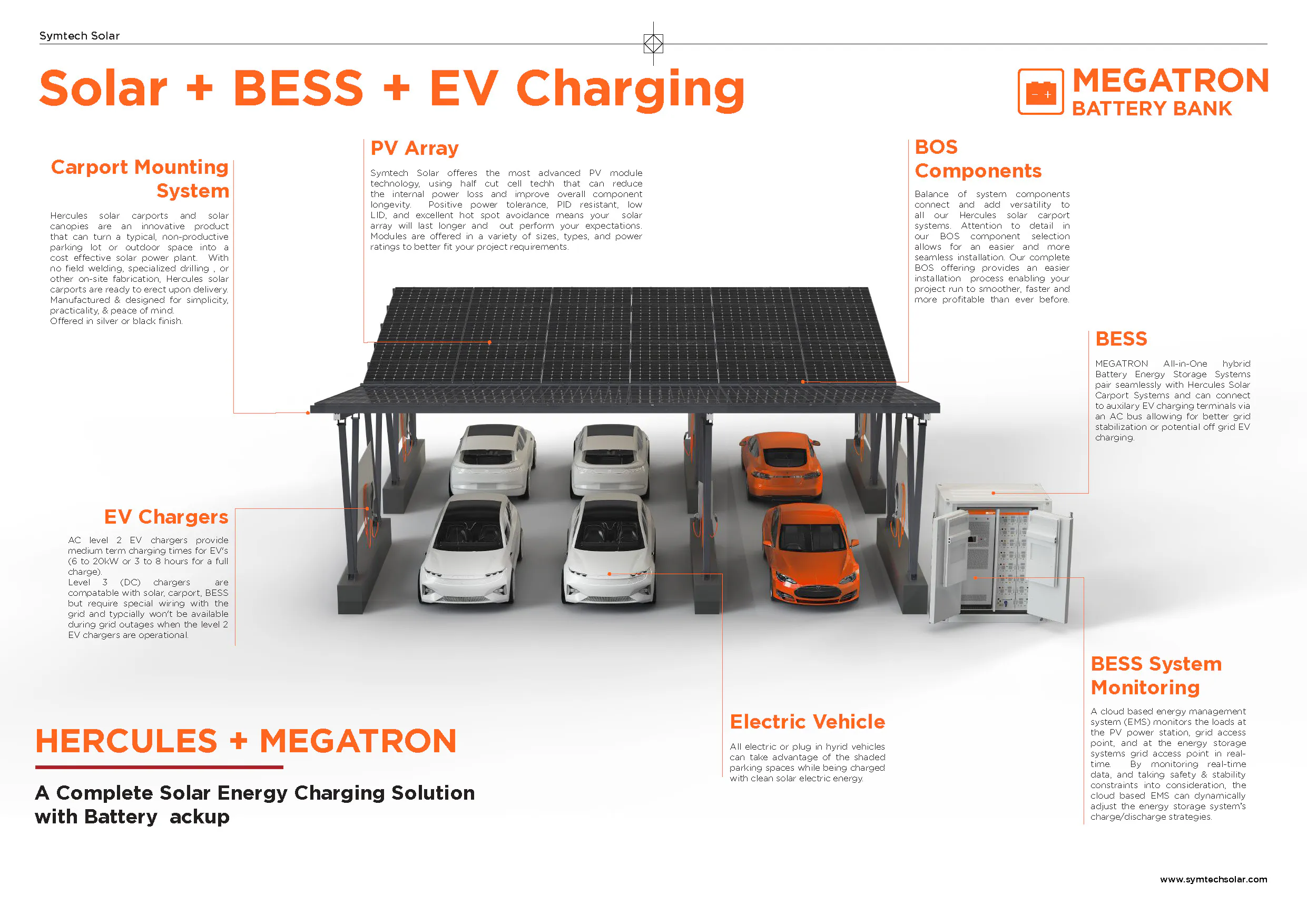
Here’s what each part of the system does:
- Carport Mounting System — The Hercules solar carport structure itself. It’s a non-welded, pre-engineered design built to convert an ordinary parking lot into a solar power plant without on-site fabrication—available in silver or black finish.
- PV Array — The solar panels mounted on the carport roof, using half-cut cell technology to reduce internal power loss and improve durability against hot spots and light-induced degradation (LID).
- BOS Components (Balance of System) — The supporting hardware—wiring, connectors, mounting hardware—that ties the solar array, inverter, and battery system together into one cohesive, easier-to-install package.
- BESS — The Megatron all-in-one hybrid battery energy storage system, built to integrate directly with the Hercules carport and connect to EV charging terminals via an AC bus for better grid stabilization or off-grid charging capability.
- EV Chargers — Level 2 AC chargers (6–20 kW, roughly 3–8 hour full charge) and Level 3 DC fast chargers, which can pair with solar and BESS but need special grid wiring and typically won’t operate during outages the way Level 2 chargers can.
- Electric Vehicle — Any EV or plug-in hybrid parked and charging under the shaded carport, drawing clean, stored solar energy.
- BESS System Monitoring — A cloud-based energy management system (EMS) that tracks real-time loads at the solar array, grid access point, and storage system, dynamically adjusting charge and discharge strategy to keep everything running safely and efficiently.
Together, this is Symtech Solar’s Hercules + Megatron pairing: a complete solar, storage, and EV charging system designed to work as one unit rather than a collection of separate parts.
BESS for EV charging: System Sizing in Practice
A single Symtech Solar BESS cabinet rated at 130 kW / 261 kWh (roughly a 0.5C discharge rate) illustrates the sizing logic behind this approach. At maximum continuous discharge, the cabinet delivers approximately two hours of full-power output (261 kWh ÷ 130 kW ≈ 2 hrs) before requiring a recharge cycle—with actual dispatchable energy reduced further once depth-of-discharge (DoD) limits and round-trip efficiency losses (typically 85–90% for lithium-ion systems) are applied.
The BESS operates in parallel with the grid connection rather than in place of it. During an EV charging event, the cabinet’s inverter discharges to cover the instantaneous power draw, while the grid supplies the balance of load and replenishes the battery’s state of charge (SoC) during inter-session idle periods or scheduled off-peak windows. For loads at or below the cabinet’s 130 kW discharge ceiling, the BESS can carry the session’s draw with minimal grid contribution. For higher-power loads—150 kW, 250 kW, or 350 kW+ DC fast chargers—the system operates in a load-sharing mode: the cabinet discharges at its rated 130 kW while the grid concurrently supplies the residual demand above that threshold.
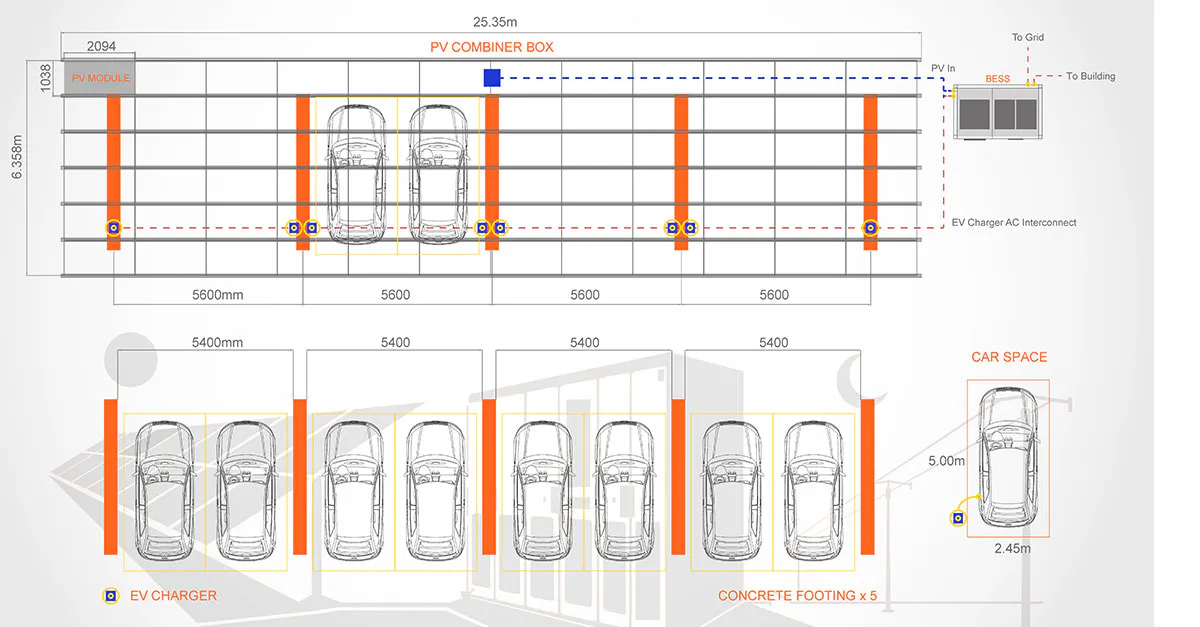
The metric that actually drives utility billing is net metered demand—the coincident peak measured at the utility meter, not the charger’s instantaneous draw. By discharging in sync with the load spike, the BESS effectively performs peak shaving, reducing the site’s measured kW peak and, by extension, its demand charge for the billing period. The battery doesn’t offset total energy consumption in this grid-only configuration—kWh delivered to the vehicle is still sourced from the grid—but it decouples the timing of that draw from the grid’s instantaneous supply.
Because the two-hour full-power discharge window doesn’t span an entire duty cycle, cabinets are typically sized around expected session frequency and charged during off-peak tariff windows or low-utilization periods to maintain SoC headroom ahead of the next demand event. For sites with higher aggregate load requirements, cabinets can be paralleled to scale both power (kW) and energy (kWh) capacity, allowing the BESS fleet to track total site demand as charging infrastructure is added.
The same hardware and control logic apply in a solar-integrated configuration—the inverter and battery architecture are unchanged; only the charging source shifts from grid-only to a blend of grid and on-site PV generation.
Finding the Right Fit for Your Site
Both approaches lower demand charges and help avoid costly grid upgrades. Which one fits best depends on your site: your utility rates, your parking layout, and your budget. Symtech Solar helps EV charging operators, retail sites, and fleet depots understand where their demand charges are coming from, then designs a system—with or without solar—that pays for itself in utility savings.
If demand charges or a costly grid upgrade are standing in your way, a properly sized battery system may solve it faster and cheaper than you’d expect.
Want to see what fits your site? Contact Symtech Solar to talk through your options.
For a deeper dive into how demand charges are structured, the U.S. Department of Energy’s National Renewable Energy Laboratory publishes a clear breakdown of how utilities calculate and apply them: NREL: An Introduction to Demand Charges. And for context on how DC fast charging power levels are classified and where the industry is headed, the DOE’s Alternative Fuels Data Center maintains a good reference: AFDC: Electric Vehicle Charging Stations.