
Can AI hackers take down the power grid? Not by themselves, and not yet. AI can lower the cost and skill needed to attack, but the damage in real incidents still comes from old weaknesses: internet-exposed remote access, default passwords, poorly segmented networks and no local fallback. Solar and battery cybersecurity comes down to four fixes: keep control systems off the public internet, segment and monitor the network, verify firmware and suppliers, and design every site to keep operating safely when communications drop.
That matters more each year, because solar farms and battery storage systems now sit at the center of grid balancing, and software controls every one of them. Here is what has actually happened, what could happen next, and what works.

Why Is AI Putting the Grid Under Pressure?
AI cuts both ways. Data centers, advanced manufacturing and electrification are adding load fast, while AI tools help utilities manage a grid that is more distributed and more complex every year.
Singapore’s SP Group shows the upside. In a sponsored interview with Asian Power, Group CEO Stanley Huang described a mix of digital twins, distributed energy resource management systems (DERMS), virtual power plants and AI analytics. The goal is to move from reactive repairs to anticipating faults. One AI tool now diagnoses power-quality disturbances in minutes, a job that once took engineers hours of waveform review. Because Asian Power published it as a sponsored feature, treat it as SP Group’s own account rather than independent validation.
The same interview carries the warning label. SP Group runs an AI governance framework and a risk review before any deployment, and Huang is clear that accountability for critical operating decisions stays with human grid teams. That is the right instinct. A grid that relies on software for its intelligence also relies on software for its attack surface. For the demand side of this story, see our guide to BESS for AI data centers.
What Does AI Actually Change for Grid Attackers?
Less than the headlines suggest, but not nothing. The U.S. Department of Energy’s CESER office sorts AI risk into four buckets: unintentional AI failures, adversarial attacks on AI systems, hostile use of AI, and compromise of the AI software supply chain. DOE also warns that AI can help less skilled attackers punch above their weight. Its AI-FORTS program now funds work on three fronts: defending against AI-enabled attacks, using AI for defense, and securing the AI models utilities deploy.
Where AI shows up in real attacks is still an emerging picture. It can speed up reconnaissance, vulnerability research and malware writing. For example, CERT Polska assessed that an LLM likely wrote most of one wiper script from the Poland campaign, used against a manufacturing company rather than the energy sites, and that the script ran slowly and poorly. Even so, it does not invent new physics. Human operators ran every grid attack documented so far, from Ukraine in 2015 to Poland in 2025, using conventional tools against conventional weaknesses. In short, AI raises the cost of leaving those weaknesses open.
What Happened When Hackers Hit Poland’s Solar and Wind Farms?
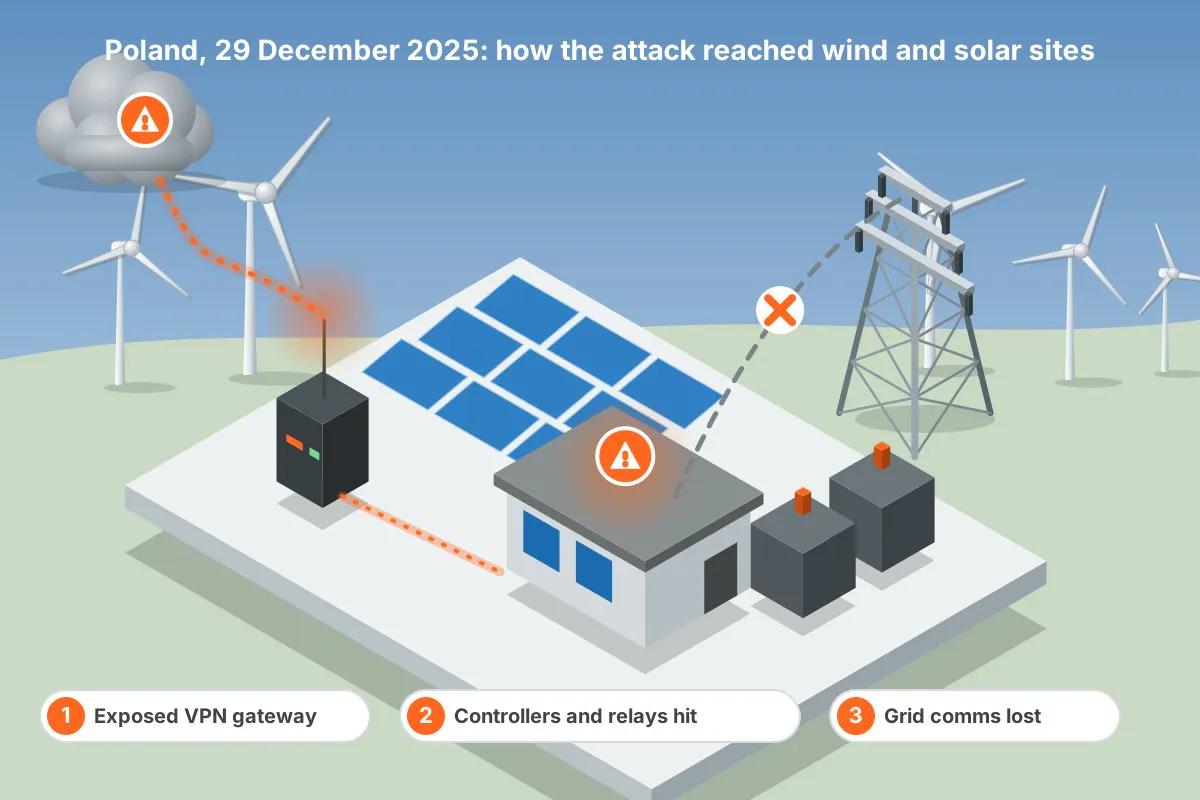
On 29 December 2025, coordinated cyberattacks hit at least 30 wind and solar farms, a manufacturing company and a large combined heat and power (CHP) plant in Poland, according to CERT Polska’s incident report. The renewable attacks targeted the grid connection point substations where each farm hands power to the distribution grid. The devices in the crosshairs were remote terminal units (RTUs), local HMIs, protection relays, serial device servers and network equipment. CERT Polska found the objective was purely destructive, and the infrastructure overlapped with an activity cluster publicly known as Static Tundra, Berserk Bear and Dragonfly.
How Did the Attackers Get In?
Surprisingly, the way in was ordinary. At every affected site, a FortiGate VPN concentrator and firewall had its VPN interface exposed to the internet, with logins that did not require multifactor authentication. Some of those devices had been vulnerable in the past, and CERT Polska noted that reusing the same accounts across facilities is common practice, so one stolen account can open many sites. Once inside, the attackers used default passwords on RTUs, relays and serial servers to upload corrupted firmware, delete system files or reset the devices. A widely used RTU family offered signed firmware updates, but the feature had to be switched on, and none of the affected units had it enabled.
Still, the lights stayed on. Damage to the RTUs cut communications between the farms and the distribution system operator and blocked remote control, but electricity generation continued. Poland’s transmission operator saw no impact on grid stability, and CERT Polska’s analysis found that even losing all 30 farms would not have destabilized the system during that period. Meanwhile, at the large CHP plant, which supplies heat to nearly 500,000 customers, endpoint detection software stopped the wiper and blocked the attack. For solar and battery cybersecurity, that is the key lesson: losing communications should never mean losing generation.
What Did the Follow-Up Report Find?
A follow-up CERT Polska report in August 2026 added a second lesson. At a smaller CHP plant supplying heat to about 50,000 residents, attackers reached the plant network through a private cellular APN. Poor network isolation was the flaw: a misconfiguration let arbitrary devices inside the APN communicate with each other. The attack shut down a steam turbine and the water treatment system, but operators responded quickly and heat supply continued. CERT Polska believes it was the first real-world attack to use that route, and its surveys suggest the same configuration is common elsewhere.
How the Poland attack unfolded, and where each step can be stopped
| 1 ENTRY | 2 MOVEMENT | 3 DAMAGE | 4 IMPACT |
| VPN gateways exposed to the internet, with no MFA, gave attackers a way in. | Admin rights on the edge device opened all subnets, VLANs or not. At one CHP plant, a private APN did too. | Default passwords let attackers corrupt RTU firmware and wipe devices at 30+ sites. | Control and comms to grid operators lost, while generation kept running and the lights stayed on. |
| STOP IT WITH No inbound internet path, MFA, fast patching | STOP IT WITH Zones and conduits, unique credentials | STOP IT WITH Change defaults, enable signed firmware updates | STOP IT WITH Local autonomy and safe defaults |
Figure 1: The Poland attack path, step by step, with the control that breaks each step. Source: CERT Polska incident reports, January and August 2026. The private APN route was seen at a second, smaller CHP plant.
Has a Cyberattack Already Taken a Solar and Battery Site Offline?
Reportedly yes, in Chile, though the facts are still thin. Chile’s National Electric Coordinator recorded a cyberattack on 27 August 2026 at the 103 MW Huatacondo solar park and its 98 MW/312 MWh battery system, forcing both off the national grid. According to Energy-Storage.news, the coordinator’s report for 27 October still listed both installations at 0% availability, two months later. The same daily report logged a forced disconnection of a transformer at the Santa Rita substation and the loss of supervisory control and remote operation at two thermal power plants, all attributed to cyberattacks.
Read this case carefully, however. The coordinator’s reports record the cause that operators communicated, not a technical investigation, and no public statement has established the origin of the attack, which systems it affected, whether the same-day incidents were connected, or why Huatacondo has stayed offline so long. The battery system was also still being commissioned, so its outage is not two months lost from a mature commercial operation. Moreover, a review of 360 daily reports found no other incident in the prior year explicitly described as a cyberattack, which suggests such reports are uncommon. Even so, Chile’s National Energy Commission opened a public consultation on a cybersecurity technical standard for the electricity sector the very next day.
Could a Hacked Battery Fleet Destabilize a Grid?
Possibly, and the mechanism is not exotic. A grid stays stable only while supply and demand balance from second to second, and batteries now help provide that balance. If an attacker manipulates setpoints so that many batteries charge or discharge in unison, or delays how fast they respond to grid signals, the sudden swing in power can disturb grid frequency and stability. The effect looks like a distributed denial-of-service attack on the grid itself. In fact, no battery is damaged. The grid simply loses its balance.
Grid cybersecurity firm Centrii examined this risk in its 2026 GRIDLOCK research paper, which ran 10,000 Monte Carlo simulations of coordinated attacks on battery fleets. Energy-Storage.news summarized the findings. Its scenario suggested that compromising about 5.4% of the ERCOT battery fleet, roughly 1,500 units, could destabilize the Texas grid. For the more interconnected UK grid, it estimated about 29% of storage assets. These are Centrii’s modeled scenarios, not independently established stability thresholds or forecasts, and Centrii sells security products. Still, they illustrate one engineering principle: a small, coordinated slice of a large battery fleet could have an outsized effect if an attacker took over its control systems, which is why fleet-level controls matter so much for solar and battery cybersecurity.
How much of a battery fleet would an attacker need?
Centrii scenario model, 2026. Illustrative, not a forecast.
| Texas (ERCOT) | 5.4% of fleet, about 1,500 units | |
| Great Britain | 29% of fleet, about 400 assets |
Figure 2: Fleet share needed to destabilize a grid in one vendor scenario. Bars show share of the storage fleet on a 0 to 100 percent scale. Source: Energy-Storage.news summary of the Centrii report.
Why Is Solar and Battery Cybersecurity So Hard?
- Remote by design. Cloud portals, cellular modems and vendor remote-access channels are how these systems get monitored and updated. Unfortunately, they are also how attackers get in.
- Many vendors, many firmware versions. Patching across a mixed fleet is uneven, and old firmware lingers for years.
- Fast actuators. Inverter-based resources, including a power conversion system (PCS), can change active and reactive power within a fraction of a second, subject to their controls and operating limits.
- Uneven regulatory pull. FERC approved NERC CIP-015-1 in June 2025 under Order No. 907, requiring internal network security monitoring for high impact and medium impact BES Cyber Systems with external routable connectivity. It does not automatically apply to every solar farm or battery site, and compliance phases in from 1 October 2028 for control centers to 1 October 2030 for other medium impact systems. Then, in August 2026, FERC approved CIP-015-2, which extends monitoring to electronic and physical access control systems and related devices, with phases running from October 2029 to full enforcement in October 2031.
How Do You Improve Solar and Battery Cybersecurity?
The fixes are unglamorous, and they work. Each one maps to a failure seen in Poland or a risk in the battery scenario above.
| Weakness | Fix | Reference |
|---|---|---|
| Exposed remote access | No inbound internet path, MFA, fast patching, brokered and logged vendor access | IEEE 1547.3-2023 |
| Flat networks, open private APNs | Zones and conduits, device isolation, internal traffic monitoring | IEC 62443-3-2, IEC 62443-3-3 |
| Dependence on cloud or comms | Local autonomy, safe defaults, independent BMS protection | IEEE 1547-2018 |
| Default passwords, unverified firmware | Change defaults, enable signed updates, secure boot, SBOM, secure development lifecycle | IEC 62443-4-1, IEC 62443-4-2, UL 2941 |
| Fleet-wide commands | Setpoint envelopes, ramp-rate caps, local charge and discharge limits, dual approval, split credentials | Design practice |
| Wipers and ransomware | Offline backups of settings and firmware, rehearsed manual operation | CERT Polska lessons |
How Do You Keep Control Networks Off the Internet?
Poland’s attackers walked through exposed VPN gateways that had no multifactor authentication, then used default passwords on the devices behind them. First, put control networks behind a firewall with no inbound internet path. Require multifactor authentication on every remote session, patch VPN appliances quickly, change every default credential, and route vendor access through a brokered, logged connection that someone approves each time. Likewise, on cellular links, block device-to-device traffic inside the private APN.
- Disable unused communication ports and services.
- Use one-way gateways where practical.
- Log every vendor remote-access session.
- Use unique credentials per site, never one shared account across a fleet.
- Separate the BMS, EMS, PCS and site SCADA networks by function and trust level.
Can a Solar or Battery Site Fail Safely When Communications Drop?
It should. After all, a site that stops working when its cloud portal disappears is a site an attacker can switch off. Grid-support functions such as the voltage and frequency ride-through defined in IEEE 1547-2018 (an interconnection and performance standard, not a cybersecurity certification) should execute in the inverter itself, not depend on a live link to a remote server. Cell-level protection in the BMS must stay independent of cloud communications and of the EMS being available. Keep the roles distinct: the BMS protects the cells, the PCS converts power and runs local grid-support functions, the EMS decides dispatch, and SCADA supervises. Our guide to the battery energy storage management system explains how these systems split the jobs.
Fail local: what keeps working when the layers above are lost
| Cloud portal and vendor access Can be lost, spoofed or attacked | Top layers can fail or be attacked |
| Firewall and DMZ No inbound internet path, MFA, logged vendor access | |
| Plant controller Setpoint envelope, ramp-rate caps, dual approval | Keeps operating safely with no remote link |
| Inverter / PCS Ride-through and grid support run locally (IEEE 1547-2018) | |
| BMS Cell protection with no outside dependency |
Figure 3: A fail-local layout. Authority flows down, and safety never depends on the layers above. See also: IEEE 1547.3-2023 and IEC 62443.
Which Firmware Questions Matter for Solar and Battery Cybersecurity?
Solar and battery cybersecurity starts in the supply chain. Beyond where a product was built, buyers should be able to verify what code it runs. Ask every inverter and BESS supplier for signed firmware with secure boot, a software bill of materials (SBOM), a documented vulnerability disclosure process, and evidence of a secure development lifecycle under IEC 62443-4-1. IEC 62443-4-2 sets technical requirements for components. UL 2941, published by UL Solutions, began as a 2023 Outline of Investigation and became a full standard on 10 December 2025. It adds a cybersecurity layer on top of UL 1741 for inverter-based resources, with basic and advanced requirement levels. It is a certification standard that buyers can specify, not an automatic requirement for every installation. IEEE 1547.3-2023 is the guide that ties the pieces together end to end, though it is guidance rather than a mandate.
Add three practical questions to every RFP:
- How long will the manufacturer provide security updates?
- Can you disable remote access entirely?
- Can you independently verify firmware authenticity and integrity, and is that check on by default? In Poland, the signed-update feature existed but was never switched on.
How Do You Limit the Damage From a Stolen Credential?
Fleet-wide damage needs fleet-wide control, so put limits between the command and the battery. A plant controller can reject setpoints outside a safe envelope, cap ramp rates, and demand a second approval for site-wide dispatch changes. In addition, add independent local limits on charging and discharging at each site, so every site refuses a bad command even when it arrives. Split fleets across credentials and, where practical, across vendors, so one stolen password cannot move a meaningful share of a grid.
Should AI Be the Operator or the Advisor?
The advisor. AI anomaly detection can spot a battery fleet behaving oddly long before a human would. However, keep a person holding authority over critical commands, which mirrors SP Group’s approach. Treat the models as assets to protect too, since DOE flags data poisoning and adversarial inputs as real risks.
How Do Microgrids Limit the Blast Radius?
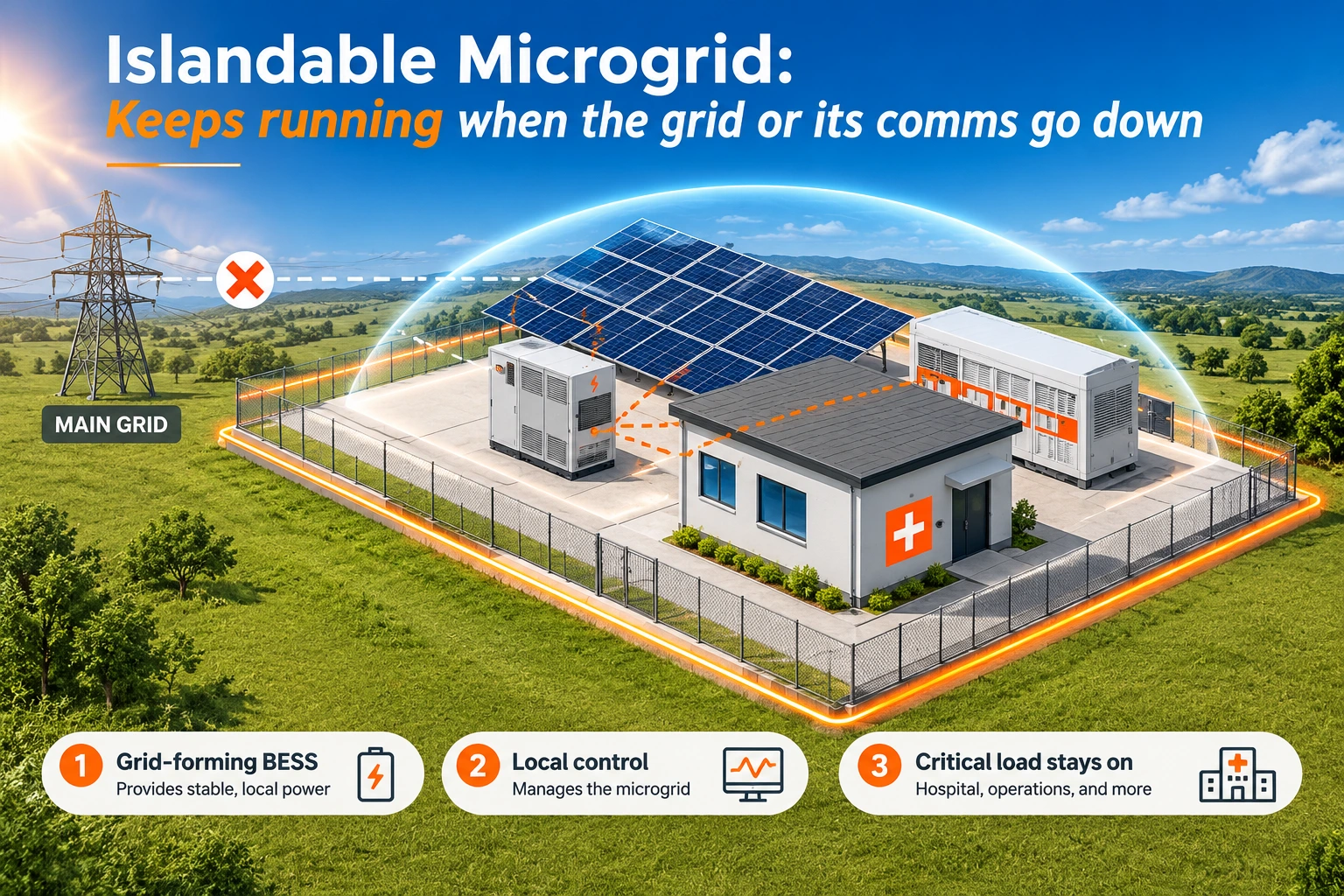
Even strong defenses can fail, so plan for it. An islandable microgrid with grid-forming battery inverters can keep critical loads running and restart locally if the wider grid or its communications go down. It is the same resilience logic behind the choice between on-grid, off-grid and hybrid battery systems. In other words, a compromised grid should not mean a dark hospital.
Solar and Battery Cybersecurity Checklist: What to Do This Quarter
- Inventory every device that can be reached from the internet, including modems, routers and vendor gateways.
- Enforce MFA and patch remote-access appliances.
- Map every vendor remote-access path and close the ones nobody can justify.
- Test what one site does when its communications are cut, then fix what you find.
- Write cybersecurity evidence (IEC 62443, UL 2941, SBOM) into supplier RFPs.
- Keep offline copies of settings and firmware, and rehearse manual operation.
Solar and Battery Cybersecurity FAQ
Can AI take down the power grid?
Not on its own. AI can speed up reconnaissance and exploitation, but documented grid attacks have used human operators and ordinary weaknesses such as exposed remote access. Basic hygiene and local fail-safes block most of the realistic paths.
Can solar inverters be hacked?
Yes, like any network-connected industrial device. Risk rises with internet exposure, weak authentication and unpatched firmware, and falls with segmentation, signed updates and limits on remote commands.
Are battery energy storage systems a cybersecurity risk?
They can be, mainly because they respond fast and are managed remotely. The main concern is not damage to the battery. It is coordinated charging or discharging across many sites that upsets grid balance.
What standards cover solar and battery cybersecurity?
The main references are IEEE 1547.3-2023 (guide for DER cybersecurity), the IEC 62443 series (industrial control system security), UL 2941 (cybersecurity testing for inverter-based resources) and, for bulk-system operators in North America, NERC CIP-015-1 and CIP-015-2.
How do microgrids reduce cyberattack risk?
A microgrid with grid-forming storage can island from the main grid and keep critical loads running locally, so a grid-side or communications failure does not have to become a site outage.
Final Thoughts on Solar and Battery Cybersecurity
In Poland, the lights stayed on because the attackers hit communications and the plants kept running. That should be the rule by design, not luck. Close the exposed doors, segment the network, verify the firmware, limit what any one command can do, and let AI advise while people decide.
Cybersecurity is a design decision, not an IT add-on. It shows up in how engineers architect a BESS: where the BMS, PCS, EMS and SCADA sit, what each can do without a network, and what a remote command can change. Specifying storage for a new project? Talk to the team behind Symtech Solar’s MEGATRON battery energy storage systems about the cybersecurity evidence your RFP should require.